
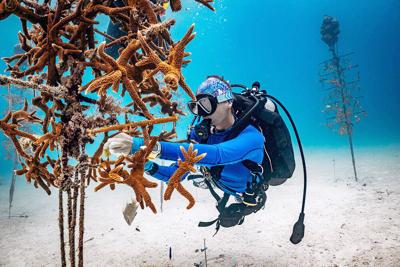
The health of our reefs, bodies of water, the Everglades, and other aspects of our unique South Florida environment are frequent topics for the South Dade News Leader.
In January 2023, a two-part story, “Restoring the Reefs,” introduced and outlined the multi-agency/organization “Mission: Iconic Reefs” Project involving seven iconic reefs, from Key Largo to Key West. (https://floridakeys.noaa.gov/)
The project includes: removal of invasive species like algae and the invertebrate Palythoa; tens of thousands of coral outplantings; surveying, data collection, and analyzing results.
NOAA recently announced a round of funding for this and another new, major project.
“NOAA has awarded $1,793,983 of an anticipated four-year, $4.2 million project to support research on multi-stressor impacts on marine ecosystems under climate change.
The newly funded project, co-led by NOAA's Atlantic Oceanographic and Meteorological Laboratory and the University of Miami Rosenstiel School, will focus on climate impacts to South Florida's coastal and marine ecosystems, including the Florida Keys National Marine Sanctuary and the southwest Florida Shelf.
South Florida's coastal and marine ecosystems provide critical ecosystem services to the Nation, supporting recreation and tourism, and generating billions of dollars for the economy and tens of thousands of jobs annually.
The well-being of over six million people in Florida's coastal counties depend on these ecosystems.
Past and current research efforts and programs typically have focused on understanding the impact of single stressors on species and ecosystems.
Unfortunately, these ecosystems are beset by a myriad of stressors, including ocean acidification, hypoxia, harmful algal blooms (HABs), increasing water temperatures, and eutrophication.
Understanding the impacts and relationships among these multiple stressors remains elusive, yet critical to understanding stressors' interactions and predicting future impacts to ecosystems in South Florida.
The goal of this project is to assess how five key stressors (ocean acidification, hypoxia, HABs, increased ocean temperatures, and eutrophication) are impacting South Florida's coastal and marine ecosystems, and to characterize the impacts of these stressors under present and future climate change scenarios, as well as Everglades, seagrass, and coral reef restoration scenarios, including Mission: Iconic Reefs.
Resource managers will use these products to prepare for the anticipated impacts of climate change by increasing their understanding as to how multiple stressors are likely to interact and affect these ecosystems and the communities dependent on them.
This award is supported by Fiscal Year 2023 funding from NOAA's National Centers for Coastal NOAA's National Centers for Coastal Ocean Science (NCCOS), Ocean Acidification Program (OAP), the Climate Program Office (CPO), and the U.S. Integrated Ocean Observing System (IOOS) Office, in partnership with the Office of National Marine Sanctuaries (ONMS).”
Additional information and links can be seen at https://sanctuaries.noaa.gov/news/nov23/ecosystems-under-stress.html
Individuals who wish to volunteer specifically with the Coral Restoration projects may do so through either NOAA or Coral Restoration Foundation at https://floridascoralreef.org; Email: info@coralrestoration.org; (305) 453-7030.
To learn more about volunteering with NOAA FKNMS, go to https://floridakeys.noaa.gov; Email: floridakeys@noaa.gov; Key Largo Office, 95230 Overseas Highway Key Largo; (305) 852-7717.

(0) comments
Welcome to the discussion.
Log In
Keep it Clean. Please avoid obscene, vulgar, lewd, racist or sexually-oriented language.
PLEASE TURN OFF YOUR CAPS LOCK.
Don't Threaten. Threats of harming another person will not be tolerated.
Be Truthful. Don't knowingly lie about anyone or anything.
Be Nice. No racism, sexism or any sort of -ism that is degrading to another person.
Be Proactive. Use the 'Report' link on each comment to let us know of abusive posts.
Share with Us. We'd love to hear eyewitness accounts, the history behind an article.