



Homeowners play vital role in saving species from extinction
Around sunset, go outside and take a look at the eaves of your home. Eye the roofline or high openings and crevices, carefully keeping watch for a special visitor that might be sharing a tiny bit of space.
Look around dusk—and for 20 minutes or so after the sun goes down—and you might just see a Florida bonneted bat darting out to begin its evening hunt for insects. What you observe might help save this species from extinction.
The Florida bonneted bat is one of the rarest bats in the U.S., and the species only lives in Southern Florida. It can roost in the eaves of homes, and it is especially likely to be found under Spanish tile roofs, so if you’re planning on construction or roof repairs for your home, be sure to watch for bats on a few different nights to see if they’re using your home to roost.
Named after their distinctive appearance—their large ears face forward, resembling a bonnet—these Federally Endangered bats are close to extinction and need your help. They have a very small home range, and if even a few bats are killed inadvertently, it can be detrimental to the species as a whole.

To learn more about the Federally Endangered Florida bonneted bat, https://floridabonnetedbat.org/
“Florida bonneted bats live from south of Orlando to Miami, and it can honestly be said that it’s a Floridian species,” says Melquisedec Gamba-Rios, PhD, who is leading Bat Conservation International’s efforts to save this species. “They’re our neighbors, and it is a responsibility for all of us to take care of our neighbors.”
With a 20-inch wingspan, they like to roost up high, so they have plenty of space to take flight. Each night, they leave their roosts and spend the evening eating insects—including mosquitoes and agricultural pests—and being fantastic neighbors that make life in South Florida even better.
They have voracious appetites, and one study found that a pregnant female can consume enough insects in a single night to match her own body weight.
Another study at Zoo Miami found that if one of the zoo’s artificial roost boxes for Florida bonneted bats was just 80% full, those bats alone could eat 21 pounds of insects per night.
The species once lived in Pine rocklands forests, which previously covered large areas of Miami Dade, but development and other factors have eliminated most of those forests, and only around 2% remain today. So, the persevering bats have turned to other places to live—like under Spanish tiles on roofs. They find tiny spaces to roost where they can find protection from the elements and predators.
“With a lot of species, when their habitat disappears, they disappear,” says Frank Ridgley, DVM, Zoo Conservation and Veterinary Services Manager at Zoo Miami. “But these smart little adaptable bats are figuring out that there are cavities under barrel roof tiles, or other kinds of cavities in buildings. But it seems like Spanish tiles are a favorite of theirs, and it’s a very popular roofing style down here.”
When you think of a group of bats, you might envision massive caves that are home to millions of bats—like the world’s largest bat colony in Bracken Cave in Texas which contains around 20 million bats during certain times of year—
or perhaps the Congress Avenue Bridge in Austin, Texas, where bats famously emerge each evening, bringing tourists out to witness the spectacle.
But you won’t see that with Florida bonneted bats. They are unobtrusive and quiet, usually roosting in small groups of 12-15 bats. You won’t smell them, but if you look closely, you might find tiny bits of guano—about the size of a rice grain—or discoloration on the upper parts of a home near any openings (though other animals can also leave similar signs behind).
Most homeowners won’t even notice they’re sharing space with bats until it’s time for construction work, so it’s smart to peek at your roof every now and then to see if you have any visitors.

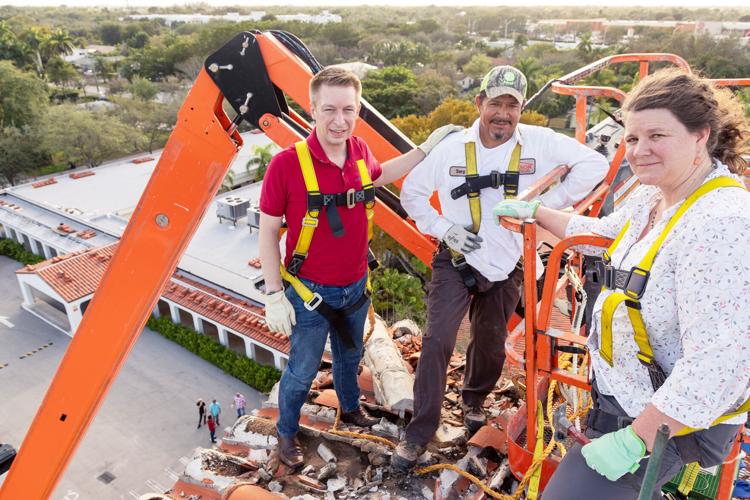
Bat Conservation International team and Bob Hilson & Company Inc help to
recover Florida bonneted bats at a roofing job site.
During a construction project, if you notice bats, stop any construction or roof work immediately and call the appropriate state or federal agency (the Florida Fish and Wildlife Conservation Commission at myfwc.com or the U.S. Fish and Wildlife Service at fws.gov).
Also, be sure to report your sighting to the Bat Lab at Zoo Miami so scientists can learn more. In Florida, all bats are protected by state law, and the Florida bonneted bat is also federally protected, so be sure to go through the correct channels to find a solution.
After professionals evaluate your situation, you will have a better idea how to proceed based on their findings. You may need to hire a licensed professional to humanely exclude the bats from your home. This typically involves installing a one-way exit on any openings so bats can leave, but not return, then waiting a few days to make sure all the bats have left. Exclusion is only allowed outside of bats’ maternity season, which can vary by species, so be sure to consult a professional wildlife expert to see when this may occur.
Attempting to remove bats yourself is illegal.
“If you’re in an area where a Florida bonneted bat could be using a roof, if you just go in and you don’t pay attention to the bats and you happen to harm the bats, killing the bats on a project, you may have wiped out an entire colony and population of this rare bat and it could literally take decades for the species as a whole to recover from that loss because they aren’t the fastest to reproduce and they have a very complex social structure,” Ridgley says.
Working together is the only way to save the Florida bonneted bat. In collaboration with Zoo Miami, Bat Conservation International is working to better understand the roosting and foraging needs for this species. With the help of homeowners, together we can find a positive solution for humans and bats alike helps promote coexistence in this little slice of paradise.

(0) comments
Welcome to the discussion.
Log In
Keep it Clean. Please avoid obscene, vulgar, lewd, racist or sexually-oriented language.
PLEASE TURN OFF YOUR CAPS LOCK.
Don't Threaten. Threats of harming another person will not be tolerated.
Be Truthful. Don't knowingly lie about anyone or anything.
Be Nice. No racism, sexism or any sort of -ism that is degrading to another person.
Be Proactive. Use the 'Report' link on each comment to let us know of abusive posts.
Share with Us. We'd love to hear eyewitness accounts, the history behind an article.