

While one of South Florida's beauties, The Everglades is typically thought of as only being filled with swamps, bugs, and gators. On April 7th, however – Everglades Day, I learned – I got a chance to be reminded about how vast and varied our backyard gem really is, and that Florida Bay is an integral part of the Greater Everglades ecosystem.
Before getting out into Florida Bay with The Everglades Foundation, and one of the three boat captains on their accompanying vessels, I first got a quick refresher from The Everglades Foundation's Chief Science Officer Dr. Steve Davis about Lake Okeechobee and how it, along with the South Florida Water Management Area helps in getting water down to us in South Florida; as well as the new Everglades Agricultural Area Reservoir: a project under construction now, set to be completed in 2034, and roughly the size of Manhattan.
"This is the heart bypass surgery for the Everglades," said Davis, "Because it allows us to then reconnect water directly from the lake, into storage, throughout the treatment, and then ultimately down through the system into Everglades National Park."

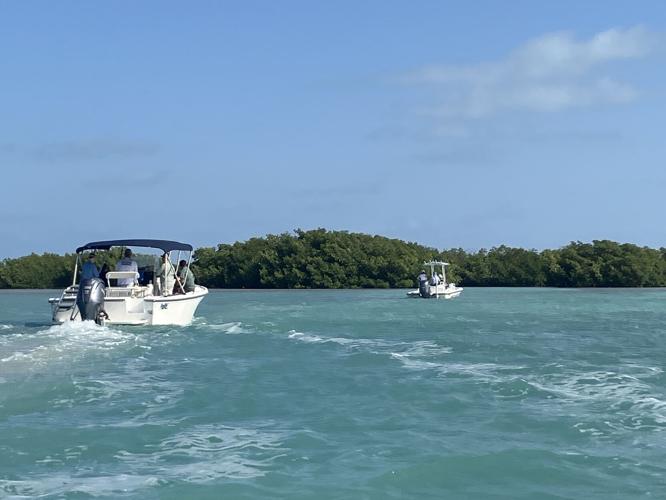
Making our way further through Florida Bay.
After the discussion, I boarded a boat captained by Dr. Thomas Frankovich, a Research Professor at FIU's Southeast Environmental Research Center, and headed out into Florida Bay. Cruising through its turquoise blue waters, I discovered that although it appeared as if I was in the ocean, Florida Bay is a series of estuary basins or areas where freshwater meets seawater, resulting in the water becoming only mildly salty.
Because of this, the roughly 800 square miles of it is home to many mangrove islands and various types of fish, birds, and even sharks and dolphins, as we spotted some on our journey. Extensive seagrass beds also play a massive role in the area's environment as they provide smaller fish a home and, thus, larger fish a food source. In 2015, a substantial seagrass die-off occurred, claiming 40-50 thousand acres.
Frankovich explained that a long, hot summer or even night affects the seawater sulfate in the Florida Bay sediment, which is detrimental to the seagrass. "That sulfate turns into a sulfide, which is toxic, and that can kill the seagrass," said Frankovich. As such, this loss affects not only the plantlife but also wildlife; the sulfur smell and large amounts of dead fish also detract visitors from venturing into Florida Bay and Everglades National Park.
In much the same way that our recent severe drought led to bone-dry land, which exacerbated the even more recent wildfires in the Keys, continuing climate change is being looked at closely, as it affects the area's salinity, noted Davis.
"Hotter water holds less oxygen," said Davis, "but the saltier the water…that also holds less oxygen." With an average length of 25 years required to recover from any damage to Florida Bay resulting from these factors, Davis discussed how The Everglades Foundation works to combat this through the water system.
"Our objective with restoration is to try to reduce the severity of these drought events," Davis said. "We know that more fresh water coming off of the Everglades into the Bay is to its benefit, and that we're starting to see the benefits of that is a positive sign."
Additionally, he spoke about the Everglades Agricultural Area Reservoir and how it's improving Florida Bay.
"It's the game changer for fresh water flow restoration," said Davis. "What we're seeing right now are just the benefits of the plumbing, the infrastructure that helps to get all of that water into the park, but once we're able to flow those larger volumes of water south, we're going to see system-wide improvement all the way down here into Florida Bay."
And with plans as extensive as these, Davis said money has been excitedly provided for the Everglades from both state and federal government, in addition to across the aisle.
"I see robust funding levels from both Tallahasse and Washington D.C.; the trend that I see in recent years is that there is a commitment to funding and getting these projects built. It's also pretty clear that this is one of the few bipartisan issues in the country: supporting Everglades Restoration, knowing its impact not only on this one-of-a-kind ecosystem, but also on our economy that's dependent on clean water."
Dr. Paul Hindsley, Chief Economist for The Everglades Foundation, further quantified how money benefits all. "Our previous work shows a 4 to 1 return on investment from Everglades restoration: for every dollar of investment in restoration we're seeing four dollars in economic benefits," said Hindsley.
Hindlsey also stated how the Everglades is critical natural infrastructure. "This importance of balance, replumbing the system is going to play a role in our water security. It's going to play a role in how we respond to extreme events in South Florida."
At a time when we all can see how devastating wildfires and hurricanes are, this eye-opening and spectacular boat tour showed me the link back to our well-being and my understanding of how crucial the role of the Everglades and its included Florida Bay is to us all.
It's not just wonderful; it's enormously beneficial. For more information on The Everglades Foundation, visit their website at www.evergladesfoundation.org.

(0) comments
Welcome to the discussion.
Log In
Keep it Clean. Please avoid obscene, vulgar, lewd, racist or sexually-oriented language.
PLEASE TURN OFF YOUR CAPS LOCK.
Don't Threaten. Threats of harming another person will not be tolerated.
Be Truthful. Don't knowingly lie about anyone or anything.
Be Nice. No racism, sexism or any sort of -ism that is degrading to another person.
Be Proactive. Use the 'Report' link on each comment to let us know of abusive posts.
Share with Us. We'd love to hear eyewitness accounts, the history behind an article.