
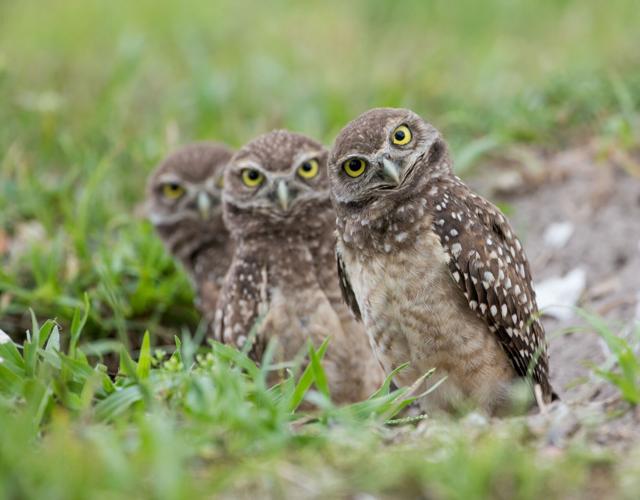
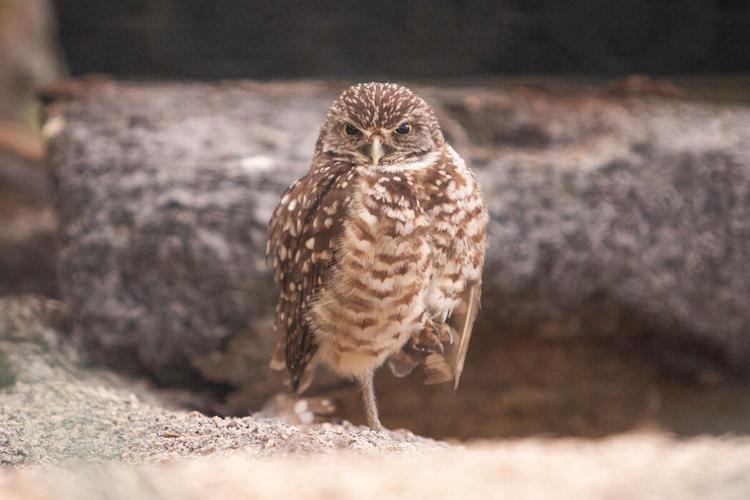
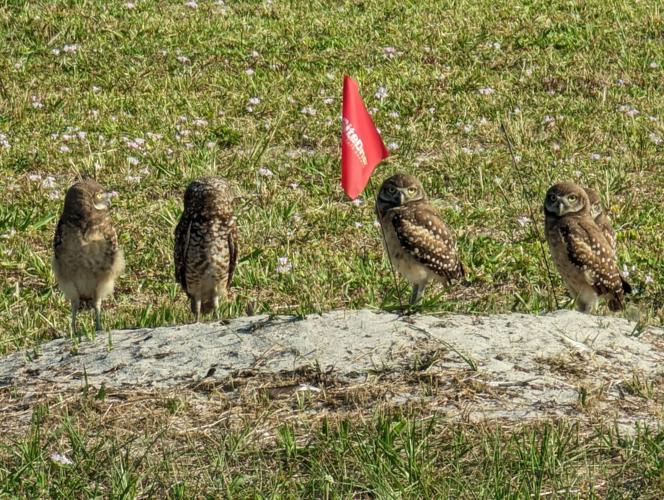
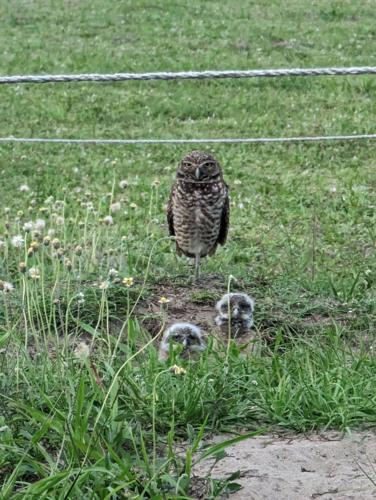
Florida’s burrowing owls are beginning their nesting season, and residents may soon notice the small, curious birds appearing in neighborhoods, parks, and even golf courses as they establish underground homes.
As Florida’s population continues to grow, wildlife is increasingly adapting to live alongside people. According to projections from the U.S. Census Bureau, the national population could reach nearly 370 million by 2080, intensifying land-use pressures and making coexistence with native species more important than ever.
Burrowing owls, though small in size, play an important role in Florida’s ecosystem and are a notable example of wildlife successfully living near human development. These native birds are the focus of a newly released Ask IFAS publication, Wildlife of Florida Factsheet: Burrowing Owl, now available in Spanish. The guide outlines what residents can expect during nesting season and offers practical steps for protecting the species.
UF/IFAS wildlife experts emphasize that burrowing owls are a protected species. Residents are encouraged to maintain vegetation under five inches around burrow entrances, use light equipment such as weed trimmers, and avoid heavy machinery near nesting areas.
Florida’s burrowing owls are a geographically distinct, nonmigratory subspecies, meaning they remain in the state year-round, unlike their western counterparts. They are active both during the day and at night and are even capable of hovering in midair — a rare behavior among owls.
Nesting season typically runs from January through March. During this time, experts advise avoiding disturbance of burrows or mowing nearby areas. The breeding season extends from February through July, with eggs incubating for approximately 21 to 28 days. Chicks generally fledge about 12 weeks after hatching. Young owls emerge from their burrows at around two weeks old and remain with their parents until they become self-sufficient.
Burrowing owls often dig their own burrows but may also occupy abandoned burrows created by gopher tortoises or armadillos. In urban settings, they have been known to use man-made structures such as manholes, sewer drains, and PVC pipes. The birds commonly decorate burrow entrances with feathers, insect parts, grass clippings, and debris — a behavior believed to help deter predators.
Residents can help support burrowing owls by installing T-perches near burrow sites to give the birds better vantage points for spotting predators and prey. Experts also recommend limiting pesticide use that could reduce food sources, keeping pets away from burrows, and observing owls from a distance.
More information about Florida’s burrowing owls and tips for living alongside them is available through Ask IFAS publications provided by the University of Florida Institute of Food and Agricultural Sciences.

(0) comments
Welcome to the discussion.
Log In
Keep it Clean. Please avoid obscene, vulgar, lewd, racist or sexually-oriented language.
PLEASE TURN OFF YOUR CAPS LOCK.
Don't Threaten. Threats of harming another person will not be tolerated.
Be Truthful. Don't knowingly lie about anyone or anything.
Be Nice. No racism, sexism or any sort of -ism that is degrading to another person.
Be Proactive. Use the 'Report' link on each comment to let us know of abusive posts.
Share with Us. We'd love to hear eyewitness accounts, the history behind an article.