
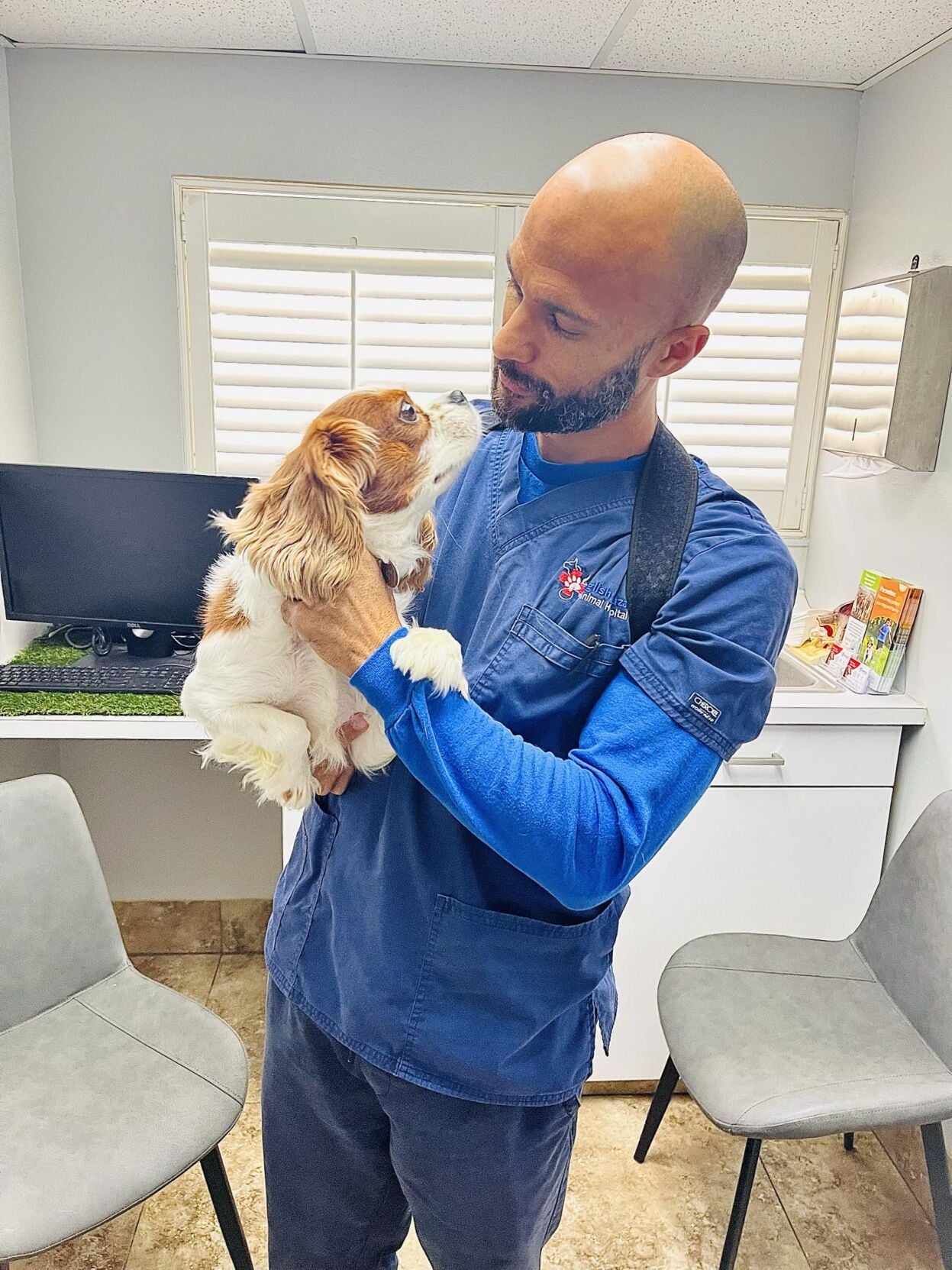
Long before Alexandre Contreras began developing a platform to connect veterinary assisting students with local clinics, he was a Homestead kid watching animal shows and imagining a future caring for pets.
Now, after roughly two decades working in veterinary medicine, the Homestead Senior High School graduate wants to help students from his community turn that same interest into practical experience.
His latest project, VetTrackEDU, is being developed to help schools, students and animal hospitals coordinate clinical placements, track volunteer hours and document the skills students learn. Contreras said he is working toward an initial pilot involving four students at his alma mater.
The idea grew from a problem he encountered while working in animal hospitals: students eager to complete their required clinical experience could struggle to find a clinic willing to take them.
He recalled students approaching hospitals for volunteer opportunities, only to be turned away or left waiting. In his experience, concerns about liability and uncertainty about supervising students could prevent placements from moving forward.
Even when a student secured a placement, he said, paper checklists could make it difficult for schools and clinics to keep track of completed work.
Contreras wants VetTrackEDU to make that process easier. The planned platform would allow students to record hours, clinics to assign duties and verify skills, and educators to follow their progress. Students would build a digital record showing the experience behind their hours.
His goal is to develop a network of participating clinics in Homestead before pursuing opportunities elsewhere.
“This is just building relationships,” Contreras said.
For Contreras, those relationships begin in a community where he has spent his life.
He credits his late grandfather with introducing him to animal programming. One show, “Emergency Vets,” made a lasting impression by showing him the work of veterinary technicians inside an animal hospital.
When he told his mother what he wanted to do, she initially pictured him becoming a veterinarian. But Contreras was drawn to the hands-on role of the technicians he watched.
After graduating from Homestead Senior High, he said, he enrolled in Penn Foster and began working at an animal hospital in Kendall. He started as a kennel assistant, taking night, weekend and holiday shifts before moving into the treatment area.
“You got to put the time in, you got to put the work in,” he said.
Contreras said he spent 10 years at that hospital, eventually working as a dental technician. He also pursued training in canine massage therapy and began offering the service outside his regular clinic work.
His interest in entrepreneurship had roots at home. Raised by a single mother working two jobs, he said, he and his brother learned to earn money for extras by cutting grass, washing cars and finding other work.
That resourcefulness later led him to develop KlipTrio, a pet nail-trimming tool designed to combine clippers, a nail file and a disposable cartridge of styptic powder. Contreras said the idea came from wanting a cleaner, more convenient way to handle bleeding when a pet’s nail is clipped too short.
Alongside his business efforts, he founded PetTrio Charity to support animals, pet owners and opportunities for young people interested in veterinary careers.
“I’ve always wanted to have a social calling attached to me,” he said.
Contreras credits C.A.R.E., Companions and Animals for Reform and Equity, and Maddie’s Fund with helping him get the charity started. He said C.A.R.E. helped him establish the nonprofit and connected him with early support, including a grant through Maddie’s Fund and donated dog food that he distributed locally.
That assistance translated into community outreach. Contreras said a pet-food distribution held at Homestead Senior High alongside Farm Share provided more than 3,000 pounds of dog food. He also described donations to Somerset Academy in Homestead and Redland Dog Sanctuary.
He hopes to continue those efforts while expanding students’ exposure to animal care.
Through visits to veterinary assisting programs, Contreras encourages students to consider the range of careers available in the field. His own experience, he said, shows that working with animals can lead to opportunities in clinical care, business and community service.
Looking ahead, he hopes to connect students with shelter experience as well as private veterinary practices. He envisions digital records that show prospective employers what a student has practiced and learned, rather than simply a total number of volunteer hours.
For now, his focus is on starting small at the school he once attended, building relationships with nearby clinics and demonstrating that the approach can work.
“This is a way of me giving back to my community,” Contreras said.

(0) comments
Welcome to the discussion.
Log In
Keep it Clean. Please avoid obscene, vulgar, lewd, racist or sexually-oriented language.
PLEASE TURN OFF YOUR CAPS LOCK.
Don't Threaten. Threats of harming another person will not be tolerated.
Be Truthful. Don't knowingly lie about anyone or anything.
Be Nice. No racism, sexism or any sort of -ism that is degrading to another person.
Be Proactive. Use the 'Report' link on each comment to let us know of abusive posts.
Share with Us. We'd love to hear eyewitness accounts, the history behind an article.