
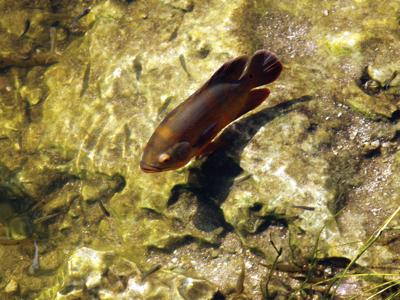
Look in any cypress strand, gator hole, lake, or canal in Everglades National Park or Big Cypress National Preserve and you will see an incredible variety of fish. The freshwater swamp is home to dozens of species, native and invasive. Visitors to Everglades National Park and Big Cypress National Preserve from outside Florida and beyond might recognize a few species from back home. With their permission, peek in any angler’s bucket, and see what they’ve been catching. For visitors and anglers, the sheer variety and abundance of fish in the Everglades and Big Cypress make the freshwater resource almost as diverse as Florida’s ocean shallows and coral reefs.
Travelers not familiar with Florida fishes are often intrigued by the Florida gar, a spotted cigar-shaped, prehistoric predator with a long jaw full of sharp teeth. The unusual name comes from the Old English word for spear. A gar’s throwback appearance is appropriate as it belongs to a family of fishes that has been around for over 100 million years. Being equipped with an air bladder helps the gar survive low-oxygen environments. Gars hunt by remaining almost motionless near the surface, waiting to snatch unsuspecting prey that gets too close. Although a delicacy among the Seminole and Miccosukee Indians, anglers who enjoy a spirited fight from a gar, may balk at preparing the bony flesh for a meal.
The Everglades and Big Cypress are also home to another Florida native, the tarpon, the famous fighting “silver king” that has drawn adventurous anglers to southern Florida for more than a hundred years. Visitors may be thrilled by the sight of a large tarpon gliding in the canals alongside alligators and freshwater fish. Tarpon are renowned as a game fish, and anglers hooking tarpon are in for a good fight. While unparalleled as a fighting fish, the tarpon is no prize as an eating fish. Like the gar, the tarpon’s muscular flesh is bony, thus catch-and-release is the watchword for most sportspeople.
Not all of the fascinating fish of southern Florida are native to the state. Like expressways into the swampy interior, canals have spread dozens of invasive species. The reasons for the introduction of these non-natives are as varied as the species themselves. Some, like the small pike killifish, were released by researchers decades ago. Blue Tilapia which are raised on fish farms, have been flooded during hurricanes, thus spreading the invasive throughout our canals. The Tilapia chases our native Large-mouthed Bass off of its nesting sites, thus changing the type of fish species we see today.
Two other invasive species that visitors are likely to encounter are the Walking Catfish and the Oscar. As the swamp dries out from November to April, the “walker”, as the Walking Catfish is known to anglers, can sometimes be seen crawling across roads or prairies in search of water. Walkers are often seen popping to the surface in canals as they take gulps of air to help them bottom-feed in the low oxygen gloom below.
A popular aquarium pet, the Oscar with vertical stripes and a circular bulls-eye located on its tail, was introduced by fish breeders in Dade and Broward counties in the 1950s and presently is breeding in canals along the Tamiami Trail and the Turner River road in Big Cypress. Like many fish species, Oscars become aggressive during mating and nesting, and an angry Oscar chasing other fish from a nest is a common sight in the early wet season. This aquarium pet has gained popularity with anglers as a tasty food fish, and Oscars make up a good part of the catch along the Tamiami Trail.
So the next time you visit our wild lands, take a closer look at what’s in the water next to the alligators and snakes.
Fishing is a popular activity in many areas of the greater Everglades region. Within areas managed by the National Park Service, there may be areas open or closed to fishing. Be sure to check at visitor centers or with park service staff to find out where you can legally fish. It is also important to familiarize yourself with the State fishing regulations and if the area you are fishing in has site specific regulations.
An avid fish watcher, Rudi Heinrich is a park guide at Big Cypress National Preserve. A native to Florida, he has been with the national park service for 4 years.

(0) comments
Welcome to the discussion.
Log In
Keep it Clean. Please avoid obscene, vulgar, lewd, racist or sexually-oriented language.
PLEASE TURN OFF YOUR CAPS LOCK.
Don't Threaten. Threats of harming another person will not be tolerated.
Be Truthful. Don't knowingly lie about anyone or anything.
Be Nice. No racism, sexism or any sort of -ism that is degrading to another person.
Be Proactive. Use the 'Report' link on each comment to let us know of abusive posts.
Share with Us. We'd love to hear eyewitness accounts, the history behind an article.