
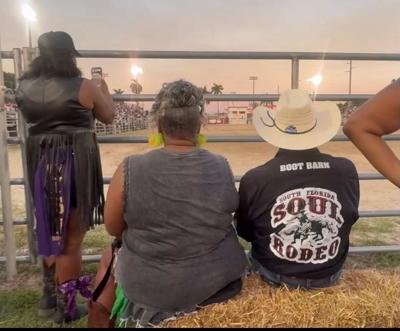
What struck me most about this weekend’s South Florida Soul Rodeo wasn’t just the energy, the music or even the competition itself.
It was the unmistakable feeling that spaces like this matter now more than ever.
At a time when Black history, Black political representation and even the legitimacy of Black communities’ voices are increasingly being challenged across this country, the Soul Rodeo felt like cultural affirmation. It felt like visibility. It felt necessary.
This weekend in Homestead, thousands of people gathered at Harris Field for an event rooted in a tradition too often erased from the broader American story: Black cowboy culture. Long before Hollywood romanticized the American West, Black cowboys helped build it. Yet their contributions have routinely been written out of textbooks, media and popular memory. Events like the South Florida Soul Rodeo are not simply celebrations. They are acts of preservation.
And in today’s political climate, preservation itself has become political.
As courts continue reshaping voting rights protections and redistricting battles threaten Black representation nationwide, including here in Florida, gatherings like this become even more important. Recent Supreme Court decisions surrounding race and representation have sent a clear message to many communities: political power and cultural visibility can no longer be taken for granted.
That reality hangs heavily over places like South Dade.
For decades, Black communities in South Florida have helped shape the cultural, economic and political identity of Miami-Dade County while simultaneously fighting to be fully seen within it. Too often, conversations about Miami center luxury developments, tourism campaigns and political spectacle while overlooking the communities that built much of this county’s cultural backbone in the first place.
The Soul Rodeo pushed back against that invisibility.
You could see it in the crowd. Families from across South Florida gathered together — Black families, Hispanic families, longtime Homestead residents, newcomers, horse enthusiasts, small business owners, activists and children seeing parts of their heritage reflected back at them proudly and unapologetically. There was joy there, but there was also something deeper: ownership.
Ownership of space. Ownership of culture. Ownership of history.
And frankly, that matters at a moment when so many communities feel like their voices are being diluted politically and culturally at the same time.
What made the rodeo so powerful was that it didn’t feel performative. It wasn’t a corporate diversity campaign or a polished branding exercise designed for outsiders. It was community-driven, deeply local and authentic to South Dade’s identity. The music, the food, the fashion, the traditions and the intergenerational families in the stands all reflected a side of South Florida that deserves far more investment, protection and recognition than it often receives.
It was also encouraging to see leaders like Mayor Charlotte Thompson and local council members continuing to bring renewed energy, visibility and hope to South Dade communities that for far too long have felt overlooked.
Some people may look at events like this and simply see recreation. I see civic importance.
Because representation is not only about who sits in elected office or how district lines are drawn on a map. Representation is also about whose stories are told, whose traditions survive, whose communities are visible and whose culture is allowed to occupy space unapologetically.
That is why weekends like this matter.
The South Florida Soul Rodeo reminded us that South Dade is still rich with culture, resilience and pride despite the pressures reshaping our communities every day. It reminded us that preserving Black history and cultural spaces cannot become an afterthought. And it reminded us that in moments where division and erasure feel increasingly institutionalized, simply gathering together in celebration of community can become its own form of resistance.
South Florida needs more than development projects and political slogans right now.
It needs spaces where people still feel seen.

(0) comments
Welcome to the discussion.
Log In
Keep it Clean. Please avoid obscene, vulgar, lewd, racist or sexually-oriented language.
PLEASE TURN OFF YOUR CAPS LOCK.
Don't Threaten. Threats of harming another person will not be tolerated.
Be Truthful. Don't knowingly lie about anyone or anything.
Be Nice. No racism, sexism or any sort of -ism that is degrading to another person.
Be Proactive. Use the 'Report' link on each comment to let us know of abusive posts.
Share with Us. We'd love to hear eyewitness accounts, the history behind an article.