
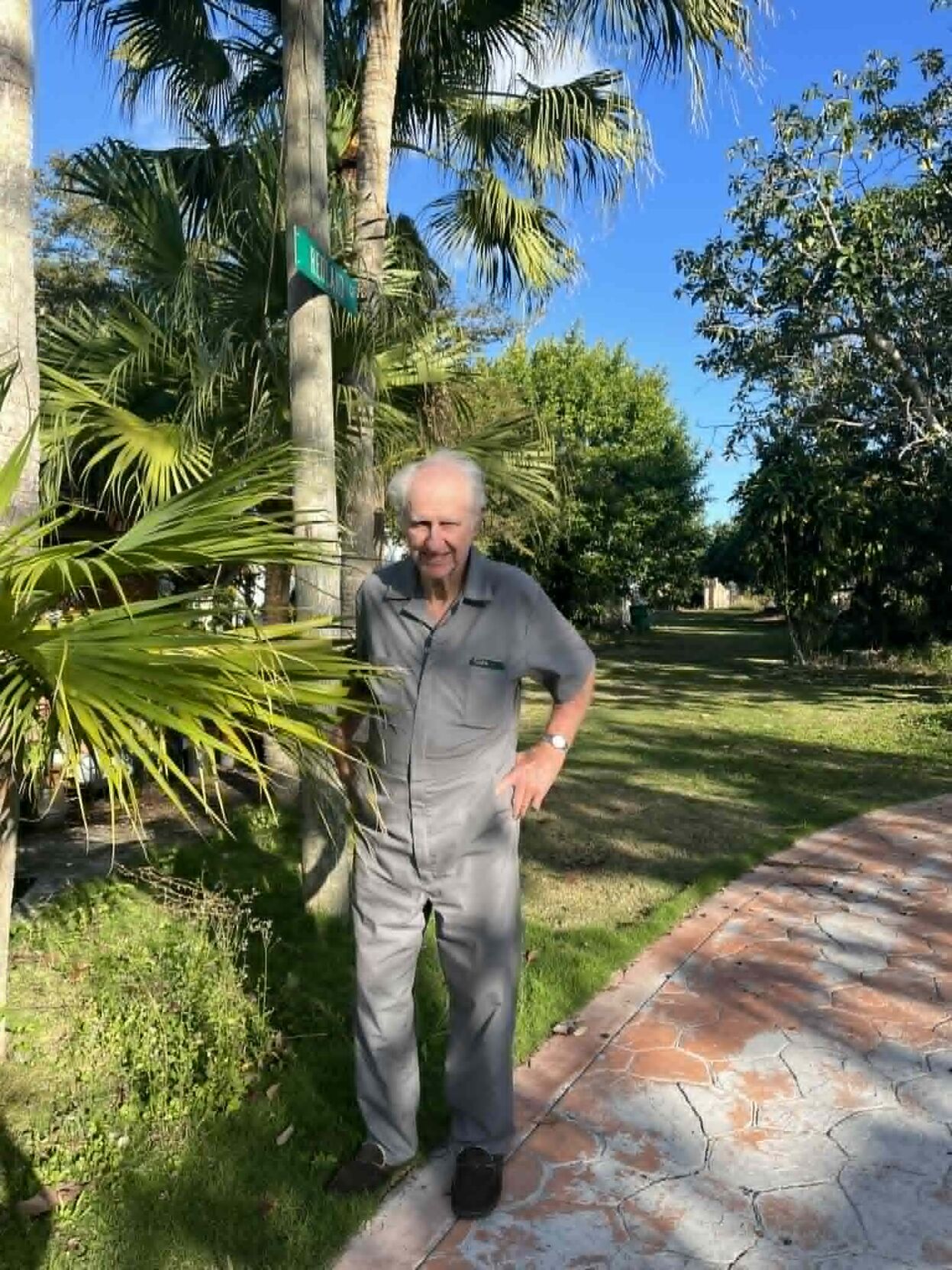
Envisioning Redland as once being thick with pines, where timber was routinely harvested, may be difficult for some. Sidney Robinson, however, traces his grandparents’ arrival in the area back to the late 1930s and early 1940s.
The family lived in several places, and when his grandfather persuaded William Sottile, a major landowner, to sell him ten acres at Krome Avenue and Lucy Street, one of his arguments was along the lines of, “You own so much property and there’s nothing here. Why not give a truck farmer a chance?” That $300 parcel of land has certainly changed over the decades.
Although the family later moved to Hialeah, Robinson returned to Redland after graduating high school in 1954 and spent time in Anderson’s Corner. He fondly remembers conversations with William Anderson and admired the man’s yellow-and-black 1941 Packard.
Those were the days when roads had names rather than numbers, and telephones operated on eight-party lines with numbers like 402XR4. Callers were connected by an operator rather than direct dialing.
When Robinson met Maryannette through a mutual friend, she was a “city girl” living in Coral Gables. Her family had moved from Ohio in 1947, and she wasn’t sure what life in rural Redland would be like.
They married in 1965, and the five-acre property they eventually settled on included a one-bedroom “cracker house” built in the early 1900s that was gradually expanded over time.
They easily recall the main grocery store in Homestead as the Food Fair, and what is now Winn-Dixie was then Table Supply. Walking around downtown Homestead and stopping into Jacobsen’s or other long-gone stores meant greeting people by name and often pausing on the sidewalk to chat, since “everyone knew everyone.”
This is perhaps what they miss most as the town has grown.
One evening in October 1962, Maryannette came to Homestead for dinner with Sidney and another couple, unaware of the tense days soon to follow during the Cuban Missile Crisis.
Robinson, who worked for the telephone company at Homestead Air Force Base, learned more than most, while the general public received very limited information. Residents were stunned to see trucks and trains filled with military equipment, with little official explanation.
Maryannette later described it as “an eye-opener.” Not surprisingly, miles of telephone wire were swiftly installed as missile and other military units poured in and set up operations.
After the crisis passed, Robinson had an experience he never expected. President John F. Kennedy visited Homestead Air Force Base on Nov. 26, 1962, to thank the troops, and Robinson was assigned to stand by with the secure “Red Telephone” and hand it to the president as he stepped off the plane.
Life in the community resumed and the population continued to rise, crossing the 25,000 mark in the 1980s. Agriculture remained central to the region, often referred to as the “breadbasket for the Eastern Coast.”
The Robinsons recall especially the many citrus groves, including large expanses of grapefruit. Hurricanes, of course, were part of life. While Hurricane Betsy had done damage, no one imagined the devastation brought by Hurricane Andrew in 1992.
Like many, they did not expect the storm to strike Homestead directly. When the flat-roof portion of their house tore away, the rest of the structure held, reinforced by steel, and they were spared major structural loss. Trees were blown over, but neighbors helped right them as everyone endured weeks without electricity.
Oddly enough, their telephone still worked, and their property became “Command Central” as one of the few working phone lines available. They eventually brought the phone outside to make it easier for people to use. Even the Homestead Police made use of it, since sharp debris constantly caused flat tires and officers needed to call for assistance.
The First Church of Christ, Scientist, where Robinson was a long-time member, was destroyed in the storm and later rebuilt through the support and donations of other churches. He remained a member until the congregation became too small to maintain the building. Although the property was eventually sold, he and others continue charitable work through their nonprofit.
Faith, family, and community have always been central to the Robinsons’ lives. Their daughter, who works in administration at Zoo Miami, has remained connected to the environment she grew up in and previously worked at the Fruit and Spice Park.
Their son was originally expected to become a pole-bean farmer, but his interests led him on another path. He went on to attend university in Alabama and is now successful in real estate in Houston. The Robinsons take great pride in both their children and their eight grandchildren.
They cherish Redland despite the ongoing loss of agricultural lands and are determined to remain in an area where the five-acre rule still stands. Proposals to shift the Urban Development Boundary have become frequent, and Robinson’s position is clear: “Stay and fight it; don’t give up. Remember David and Goliath.”
Both he and Maryannette remain active in organizations dedicated to preserving the unique character of Redland.
Sidney and Maryannette Robinson enjoy their five-acre property in historic Redland and have witnessed many changes during their sixty-one years of marriage.

(0) comments
Welcome to the discussion.
Log In
Keep it Clean. Please avoid obscene, vulgar, lewd, racist or sexually-oriented language.
PLEASE TURN OFF YOUR CAPS LOCK.
Don't Threaten. Threats of harming another person will not be tolerated.
Be Truthful. Don't knowingly lie about anyone or anything.
Be Nice. No racism, sexism or any sort of -ism that is degrading to another person.
Be Proactive. Use the 'Report' link on each comment to let us know of abusive posts.
Share with Us. We'd love to hear eyewitness accounts, the history behind an article.