
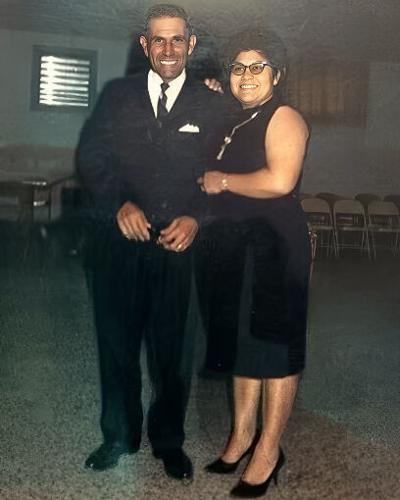
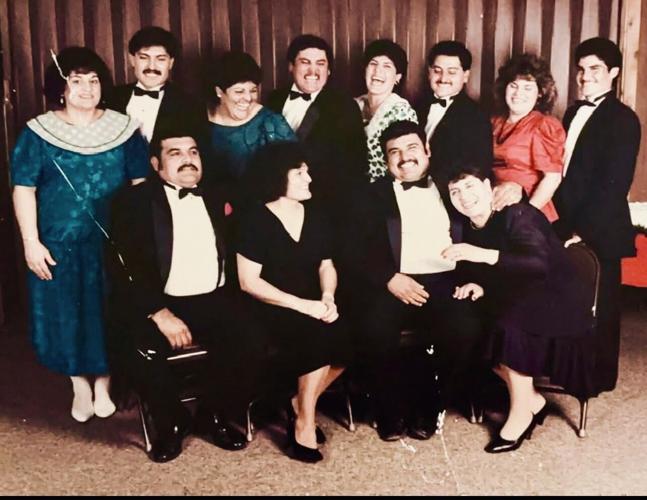
Julio and Ignacia Berrones moved to Homestead with their twelve children, guided by faith in family and the American Dream.
They were migrant workers, and in 1962, “labor camp” was the common term for South Dade Housing Authority housing. Located near Homestead Air Force Base, the family found a house within six months near what was then Miami-Dade Community College.
The infant Eduardo — Eddie — knew none of this. Like his brothers and sisters, he began farmwork at an early age. Determined to be more than “migrant,” his father became a harvest manager at Torcise Brothers Farms, overseeing tomato fields. For a time, the family traveled to Michigan during the summers for sugar beet work. Once again, his father secured a steady contract, and the additional income allowed the family to move to Florida City.
“I had a beautiful childhood,” Berrones said. “We were part of the Italian-American community, as many of the farming families lived there.”
Their mother firmly and lovingly insisted on education and a strong work ethic. After graduating from South Dade High School, the siblings followed different paths. One brother entered construction, specializing in drywall. Another founded a welding company. A sister opened a tuxedo rental business that expanded into a bridal shop and later a banquet hall. Brother Cesar opened Casita Tejas. Another brother was drafted and served in Vietnam. Other sisters pursued beauty school and nursing. Each was encouraged in their chosen direction.
When Berrones selected engineering, he agreed with his father’s belief that college in Texas was the right move — neither realizing how different his eventual path would be.
For those who did not experience Hurricane Andrew, the physical devastation was compounded by severe economic hardship. The downsizing of Homestead Air Force Base and the departure of many small business owners left the community reeling.
Berrones had taken a county job in social work and was quickly advancing, while still holding a half-ownership stake in Casita Tejas. The restaurant next to the Homestead Police Station reopened as soon as possible.
“My brother was so busy, he needed my help,” Berrones said. “People just wanted a little bit of normal, and not many restaurants had reopened.”
Once conditions stabilized, his brother purchased property across Krome Avenue and built the restaurant where it stands today.
Despite juggling multiple roles, Berrones knew social work — particularly supporting children — was his true calling. Influential community members took notice. Tim Williams and Brent Probinsky encouraged him to run for Homestead City Council, with Bob Jensen offering to manage the campaign.
If elected, he would have to leave his county job. Around the same time, Le Jardin Inc., a nonprofit early-learning organization promoting Head Start and related programs, needed an executive director. The role aligned with his dedication to breaking cycles of poverty through education.
With both decisions made, Berrones became the first Hispanic elected to the Homestead City Council in 1997.
He quickly learned the city’s finances were in serious trouble. Economic recovery lagged, property values were depressed, and revenues were limited. Berrones worked to restructure the city’s budget and financial procedures while improving public access to information to increase transparency.
At Le Jardin, despite organizational and financial challenges, Berrones recognized the opportunity to expand services by working with families, school districts, and community partners to create a stronger early-learning pipeline.
“We needed other facilities to do so,” he said.
Low property values offered an unexpected opportunity. Le Jardin secured property for $40,000 for its first new facility. Building on that success, Berrones ultimately obtained millions in grant funding. Today, Le Jardin operates nine locations and employs more than 450 people.
As Florida began moving toward charter schools, Berrones saw another path forward for a community where county school resources were not equitably distributed. A charter school corporation required ten acres. His proposal to City Council met resistance, with members insisting education was a county responsibility.
A local developer attending the meeting spoke with Berrones afterward. At the time, Keys Gate was sparsely developed, in part because families were concerned about schools. After completing his council term, Berrones continued advocating for charter schools. The developer provided the ten acres, leading to the creation of Keys Gate Charter Schools.
Berrones later consulted on additional schools, and home sales increased.
“It changed the face of Homestead,” he said.
Sixty-four years later, four generations of the Berrones family remain guided by their mother’s belief: “You have to be engaged in the community you live in — assimilate.”
Berrones offers similar advice today.
“Be active,” he said. “Make a difference.”

(0) comments
Welcome to the discussion.
Log In
Keep it Clean. Please avoid obscene, vulgar, lewd, racist or sexually-oriented language.
PLEASE TURN OFF YOUR CAPS LOCK.
Don't Threaten. Threats of harming another person will not be tolerated.
Be Truthful. Don't knowingly lie about anyone or anything.
Be Nice. No racism, sexism or any sort of -ism that is degrading to another person.
Be Proactive. Use the 'Report' link on each comment to let us know of abusive posts.
Share with Us. We'd love to hear eyewitness accounts, the history behind an article.