
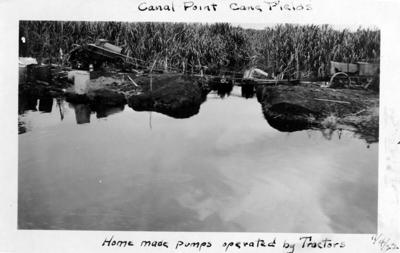
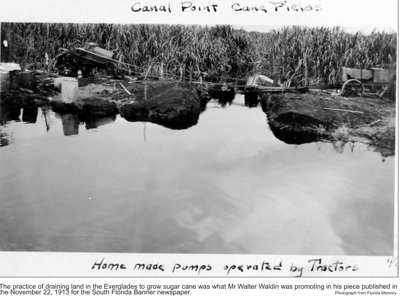
One of the values of preserving history is realizing topics or issues that seem new may instead have long histories.
Concern about development and preservation of the Everglades is certainly a subject important to many.
The following is transcribed from a November 22, 1913 piece in the South Florida Banner newspaper, “Keep Your Eye on Homestead” section.
CANE IS KING IN EVERGLADES
Sugar Cane Grows Profusely Without Any Fertilizer.
The Florida East Coast R.R. Company Should Have an Expert Agriculturist in Its Land Department
I have just paid a visit to the Everglades, the first after coming back from my Western trip, and I was certainly surprised to see the splendid crops and especially the fine sugarcane now growing west of the City in the Everglades.
The Glade land has a covering of muck about a foot deep, and is not as rich as such land usually would be further in the Glades. However, the cane is very fine and this is in spite of the fact it has had no culture or fertilizer whatever.
The stalks range as thick as one and three-quarter inches in diameter and are ten and twelve feet tall. I say this had no fertilizer or culture. In addition to this, the ground was not even plowed, merely furrows thrown up, the cane planted, then left to shift for itself.
And the size of this stalk is the result of eight or nine months growth from the setting of the cane which I think is simply marvelous.
I have often wondered just what would have happened had Mr. Flagler exerted some of his energy, and invested some of his money in the development of a small tract of Everglade land. Securing it in such a way by drains and dikes as to make it absolutely secure from overflow.
Had this been done fifteen years ago the Everglades proposition would be settled finally today. It would remove the insecure feeling that has been manifested among those who have no faith in the purchase until it has been actually demonstrated.
There is no doubt in the world but that such a tract would bring good interest on one thousand dollars per acre and where there is today a saw-grass swamp there would be a blooming field, and there is no doubt in the world, but that we could have a city the size of Jacksonville right here in Miami.
It would take a double track of railroad to transport the stuff that would be here grown. The Everglades land, instead of selling at sixty dollars an acre, would have a standard of valuation probably ten or twenty times as high.
In addition to that, our railroad would have so much freight to handle that it would keep many cars going and coming.
I have often wondered that the heads of Florida East Coast Railroad would not be careful in the selection of their officials and practice what everyone would do who do business from a strictly business standpoint.
Namely select, as our Presidents do their cabinet, such officers who are especially fitted for their individual duties.
It seems a pity that Mr. Flager could not have picked a single agriculturist to head his land development and who had faith in the land he was developing.
As it is the people are obliged to come here and tell the company about their own land and make such selection as they wish. The company is not in a position to render individual advice in any selection as they have no one who knows or seem to care less.
A thorough agriculturist should head the land department; and who can give advice; one who knows how to select land and who takes an active interest in the development along this line.
It seems poor business indeed to let a proposition which would bring in millions go for simply the want of the necessary knowledge of which can be obtained at a very reasonable figure in the open market.
Such a man would have advocated drainage of at least several sections of land in the Everglades years ago, which would have been a very small matter and the returns of which would have enriched the entire country.
Why has this not been done?
Walter Waldin.
End of Transcript.
Of note, Mr. Waldin (1877-1924) was originally from Germany and came to South Dade from Iowa. While he did have a farm at the edge of the Everglades where he held experiments showing that farming can be sustained in the Everglades, he was also a land leader during the 1920s expansion in Miami.
The largest organized collection of Homestead and area history items can be enjoyed at the Homestead Town Hall Museum.
Located across from Losner Park at 41 N. Krome Ave., it is open free of charge from 1:00-5:00 p.m., Tuesday-Sat.

(0) comments
Welcome to the discussion.
Log In
Keep it Clean. Please avoid obscene, vulgar, lewd, racist or sexually-oriented language.
PLEASE TURN OFF YOUR CAPS LOCK.
Don't Threaten. Threats of harming another person will not be tolerated.
Be Truthful. Don't knowingly lie about anyone or anything.
Be Nice. No racism, sexism or any sort of -ism that is degrading to another person.
Be Proactive. Use the 'Report' link on each comment to let us know of abusive posts.
Share with Us. We'd love to hear eyewitness accounts, the history behind an article.