
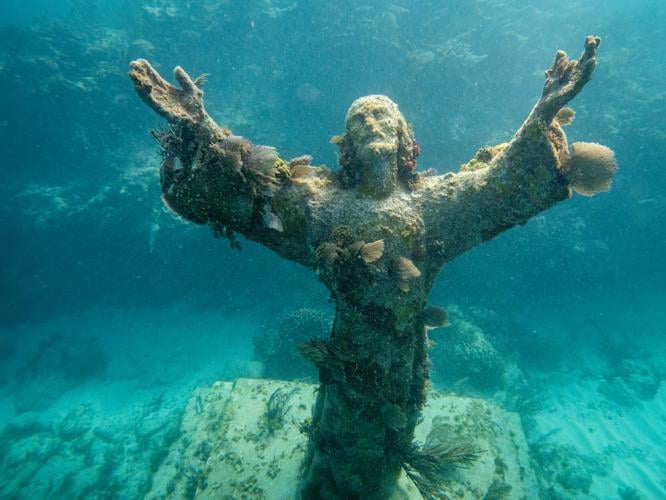
August 25th, 2024 marked the 59th year of an iconic Florida Keys diving attraction. The almost nine-foot-tall bronze statue titled, Christ of the Deep, also frequently referred to as Christ of the Abyss, was placed on its concrete base on August 25th, 1965.

This closeup of the Christ of The Deep shows the coral and other marine growth from 59 years underwater.
The statue, now almost completely covered in fire coral and with both soft corals and sponges growing on it, remains one of the most popular destinations for both divers and snorkelers visiting Key Largo and the Florida Keys.
The Italian sculptor Guido Galletti created the mold and cast the first statue in 1954. It was placed in San Fruttuoso Bay near Genoa, Italy. His title for the sculpture was in Italian, Il Christo Degli Abissi, or, in English, Christ of the Abyss. The second casting was placed in St. George's Harbor in Grenada in 1961. Egidio Cressi, who, along with his brother, founded and owned the Cressi company (manufacturers of diving equipment) commissioned a third casting to be titled Christ of the Deep.
Cressi donated the statue to the Underwater Society of America in 1961 and it arrived in Chicago during 1962. The Society spent several years determining the best location for the statue, finally choosing John Pennekamp State Park, the first undersea park in the United States. The park then chose the reef known as Key Largo Dry Rocks and work began to fabricate a concrete base.The statue was placed in its permanent location on August 25th, 1965. It sits in around 20 feet of water with the upraised hands of the statue reaching to within 6 feet of the surface.
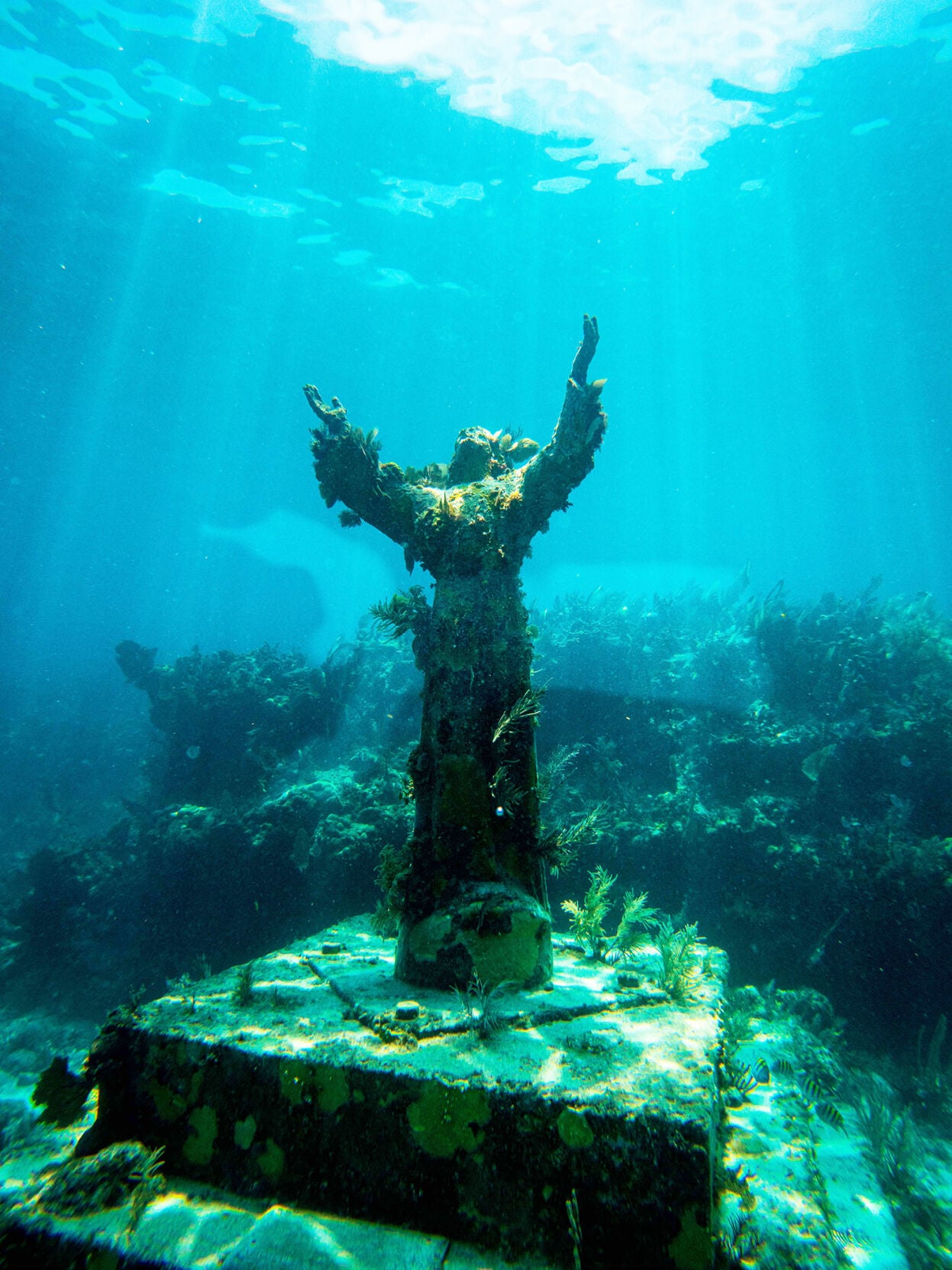
This view shows the Christ of the Deep statue and its concrete base in one of the sand channels of Key Largo Dry Rocks.
With the designation of the Florida Keys National Marine Sanctuary (FKNMS) in 1990, the boundaries of John Pennekamp were adjusted, and Key Largo Dry Rocks and the Christ of the Deep were no longer in the Park. To protect and preserve the statue and its surrounding reef, KFNMS set up a Sanctuary Preservation Area.
Within this area, clearly marked by large yellow buoys, no fishing, spearfishing, lobstering or any removal of marine organisms is allowed. Permanent mooring systems are in place so boats will not damage the reef with their anchors.

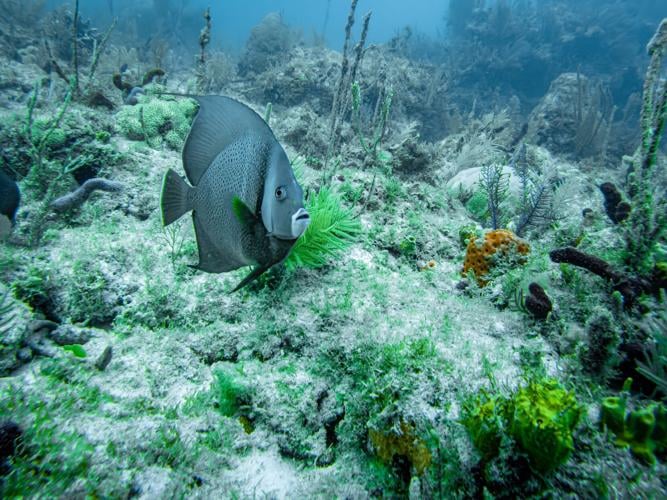
A Gray Angelfish cruises Key Largo Dry Rocks close to the statue. The relatively shallow depths make for a more colorful view easily seen by both divers and snorkelers.
The Christ of the Deep is easily accessible by private boat and is frequented visited by both Key Largo diving and snorkel charters. A great resource for additional information on the history of the Christ of the Deep including historical images, is www.keyshistory.org/artchristofthedeep.html.

(0) comments
Welcome to the discussion.
Log In
Keep it Clean. Please avoid obscene, vulgar, lewd, racist or sexually-oriented language.
PLEASE TURN OFF YOUR CAPS LOCK.
Don't Threaten. Threats of harming another person will not be tolerated.
Be Truthful. Don't knowingly lie about anyone or anything.
Be Nice. No racism, sexism or any sort of -ism that is degrading to another person.
Be Proactive. Use the 'Report' link on each comment to let us know of abusive posts.
Share with Us. We'd love to hear eyewitness accounts, the history behind an article.