
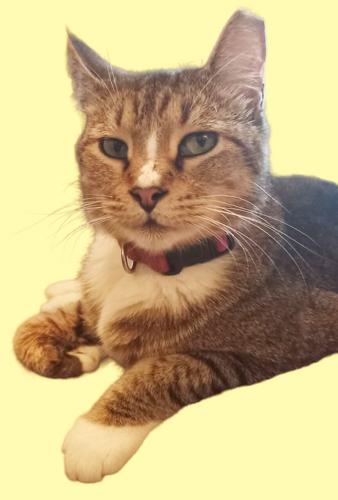

I do not often share matters of a personal nature, but I must acknowledge that it may be therapeutic to do so on some occasions.

Vincent V. Marshburn
Last year, my son Luke Marshburn wrote an article titled "Not My Cat" (February 18, 2022), in which he described how a seemingly stray cat had quite deliberately and unequivocally adopted us as his family. With some initial reluctance but then gradual sincerity on our part, we did indeed
embrace this intrusively intimate feline into our hearts. We often referred to him as "aggressively friendly"; I have concluded that he was in fact, ultimately "fatally friendly."
I am greatly saddened to report that this acclaimed cat (variously referred to as "Bobahh," "Balut," "kitty," "doofus," or some derivatives thereof) is no longer with us.
Last week, as I left for work in the morning, I let him out of the house for what would be the last time. When I returned home in the evening, I found a note in my mailbox, attached to a plastic bag containing his collar, that a kind neighbor had left, informing us that there had apparently been an accident. She had found his body near her house, around the corner. His remains have been retrieved and are now in the process of "returning to dust," as apparently all God's creatures do (Ecclesiastes 3:20).
Anyone who has lost a loved one, even a pet, knows the range and depths of emotions that overcome oneself at such an occurrence. There is often shock, disbelief, denial, panic, and confusion, and then dismay, anguish, despair, remorse, and an utter sense of loss and devastation. That place in our heart that was occupied by that source and object of love now seems somewhat hollow and void.
We are left with a pang of pining over their absence, even a twinge of abandonment or forlorn feeling of forsakenness. Raw emotion, rather than rationality or tranquility, commonly reigns during such seasons of grief.
As human beings, we regularly seek to make connections with others. This contributes to a sense of belonging, comfort, and empathy, and can even extend to bonds that are formed among people and animals.
As much as humans can exhibit and express a broad scope of intentions and emotions, animals are, often remarkably, just as capable of doing so — perhaps in some instances, even more so.
Apparently, various species beyond humans demonstrate an ability to manifest a gamut of intelligences, including cognitive and emotional.
As a human being myself (not altogether obvious, according to some) who tends to be shy, introverted, and generally unsociable, such connections do not overwhelmingly appeal to me by default, and efforts to establish them do not come easily.
I am fairly satisfied to remain aloof, independent, and even secluded at times. Isolation does not ordinarily trouble me in any meaningful manner, and I do not typically suffer from any sense of "loneliness"; I find solitude quite agreeable.
However, even I can appreciate the benefits of community and companionship. I have a wonderful and loving family, after all, and I recognize the design of the Church as "many members, one body."
And apparently, even I was not immune to the charm of an audaciously affectionate cat who shamelessly sought as much attention and
contact from me as he could get.
In the television series "Star Trek: The Next Generation," the character Data has a pet cat named Spot who appears occasionally throughout some seasons of the show.
As an android — literally, an emotionless, mechanical, artificial being — Data is programmed with curiosity and a desire to continue learning, including an
interest in understanding his creators, human beings. The exercise of caring for a pet is his ongoing study and experiment to gain insight into aspects of human thought and behavior.
In one episode, Data attempts to further explore the concept of emotions by writing a poem, an ode to Spot. The content tends to be very technical, while
attempting to adhere to basic structures and forms of poetry. It represents Data's best efforts to summarize his peculiar attachment to the animal. The closing lines are uniquely expressive of admiration and affection, from an android's perspective:
A tail is quite essential for your acrobatic talents;
You would not be so agile if you lacked its counter balance.
And when not being utilized to aid in locomotion, It often serves to
illustrate the state of your emotion.
O Spot, the complex levels of behavior you display, Connote a fairly well-developed cognitive array. And though you are not sentient, Spot, and do not comprehend, I nonetheless consider you a true and valued friend.
As someone who is inclined to resist personal attachments, I can readily endorse Data's "sentiments" as an objective observation of my feelings towards the cat who was "not our cat" who became, truly, our cat. I am borrowing Data's words as my own ode to “My Cat."
As Luke wrote previously, there are often significant lessons that God can impart to us through seemingly mundane acts such as caring for an animal. And even through this loss, I am compelled to seek God's wisdom as I confront the melancholy brought on by mourning.
The Bible indicates that God was pleased with all the forms of life he brought into being — as Genesis chapter 1 describes, he "saw that it was good."
Scripture also tells us that all of God's creation, including the animals,
attests to his awesome power and love (Job 12:7-10). And we are
assured that God cares for every little creature that has ever existed and will exist (Luke 12:6). He desires to engage in a profound and personal
relationship with this entire universe of life.
Of course, part of the risk of friendship and love is that one's heart is vulnerable to being wounded and broken; this is what I mean by "fatally friendly" — relationships have the potential to expose us to heartache and sorrow brought on by separation.
In the case of death, it is a separation that in our fallen state can be
extremely difficult to endure and reconcile.
I am certainly aware that the scale of the tragedy of death is so far beyond my own individual, seemingly minor experience.
People all around the world endure pain and horror to such depths that I cannot fathom. My belief is that God understands all our sufferings, no matter the extent or proportion.
Indeed, no one knows the bitterness, heartbreak, and even outrage brought on by death better than God himself. From the beginning, God desired that his creation should experience the fullness of life, not the desolation of death. We can only imagine the immense disappointment and sadness he must have
felt to see the finest specimens of his handiwork, humanity, catalyze the consequence of sin as they rejected his all-encompassing love and provision for life (Genesis 3:17-19, Romans 5:12).
Fortunately, God was not unprepared or caught off guard. He planned from before the beginning for Jesus to confront the burden and distress brought on by death — not only physical death that separates loved ones, but spiritual death that ultimately separates us from God. Jesus confronted, and withstood, and overcame; and through him, God's plan of redemption continues to progress towards fulfillment.
I know that the animals we choose to cherish are very much a part of the amazing creation that God himself conceived and loves and intends to redeem and restore. Perhaps the connections we make with these diverse and
delightful creatures affords us opportunities to share and express the love God has for all his creation, even "the least of these" — including, I must affirm, my cat.

(1) comment
amen. hugs.
Welcome to the discussion.
Log In
Keep it Clean. Please avoid obscene, vulgar, lewd, racist or sexually-oriented language.
PLEASE TURN OFF YOUR CAPS LOCK.
Don't Threaten. Threats of harming another person will not be tolerated.
Be Truthful. Don't knowingly lie about anyone or anything.
Be Nice. No racism, sexism or any sort of -ism that is degrading to another person.
Be Proactive. Use the 'Report' link on each comment to let us know of abusive posts.
Share with Us. We'd love to hear eyewitness accounts, the history behind an article.