
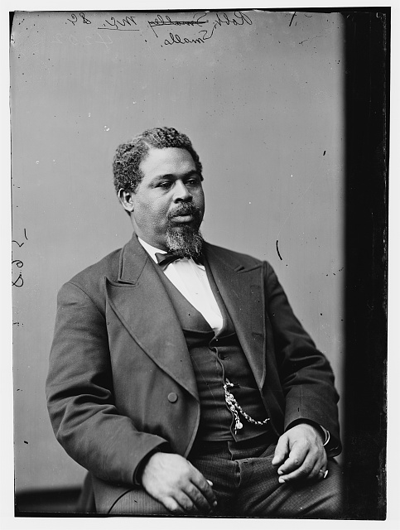
As we approach the end of Black History Month, here's one more icon whose historic victories were as big as his lived life. Robert Smalls was born into slavery on April 5th 1839, in Beaufort, South Carolina.
When he was 12 years old he was sent to work in Charleston, where he would later as an ocean loving teeanger, work at the local docks and harbor yards there. This work experience made him extremely familiar with how to navigate the daunting Charleston Harbor. As a result, in 1861 during the Civil War, he was assigned as wheelman to the CSS Planter – a Confederate Military Transport ship – under Captain Charles C. J. Relyea.
May 12th, 1862 was his last night as a slave however on this ship. As the white officers started to go ashore, leaving Smalls and the rest of the black crew behind and docked at an area wharf, Smalls requested to have his and the crew’s families come aboard to spend time with them. The officers agreed, explaining that they leave though before the curfew.
Once on the Planter, Smalls told the families his plan to take the ship with them on it and escape. When curfew came, the crew faked taking the family off, snuck them back on, and Smalls disguised as the captain in his uniform and trademark straw hat, piloted the Planter out into the harbor toward the Union Navy.
Since Smalls remembered the various ship signals used by Captain Relyea at the various harbor checkpoints, and his already extensive knowledge of the waterway, he passed through them easily, and fooled Confederates both on and off shore. Successfully steering the vessel to the Union ships, Smalls flew the white flag of surrender, and escaped slavery in the South for himself, his family, his crew, and their family.
He would then spend the next few years on the Planter, as well as the Crusader, USS Keouk, and USS Isaac Smith; his military awareness of strategic points of interest such as landmine placement made him a valuable asset as a captain and commander for the North throughout the remainder of the Civil War.
After the war, Smalls returned to his hometown of Beaufort, bought his former master's house, moved his family there, including Small’s mother Lydia Polite, and even allowed the master's elderly wife to stay there.
Becoming a local businessman, he invested in the area's economic development, owned Enterprise Railroad, and a newspaper: The Beaufort Southern Standard, started in 1872. Smalls later became involved in both state and national politics as a Republican representative in South Carolina's House of Representatives and the U.S. House of Representatives, where he created free schools for the children of South Carolina, passed laws protecting Black people, and became a major general of the South Carolina State Militia.
Passing away at the age of 75 on February 23rd, 1915, he was buried at Tabernacle Baptist Church in Beaufort, on his family's plot. A monument there contains Smalls’ quote to the state legislature from 1895. “My race needs no special defense, for the past history of them in this country proves them to be the equal of any people anywhere. All they need is an equal chance in the battle of life."
With the USS Robert Smalls named after him last year, and a movie on his spectacular life in pre-production, Robert Smalls led a big life; one that history – Black or otherwise – should never forget.

(0) comments
Welcome to the discussion.
Log In
Keep it Clean. Please avoid obscene, vulgar, lewd, racist or sexually-oriented language.
PLEASE TURN OFF YOUR CAPS LOCK.
Don't Threaten. Threats of harming another person will not be tolerated.
Be Truthful. Don't knowingly lie about anyone or anything.
Be Nice. No racism, sexism or any sort of -ism that is degrading to another person.
Be Proactive. Use the 'Report' link on each comment to let us know of abusive posts.
Share with Us. We'd love to hear eyewitness accounts, the history behind an article.