
South Dade's rapid growth has brought new residents, development and opportunity to the southern end of Miami-Dade County.
But a new report released by The Miami Foundation suggests that the region's nonprofit and community infrastructure has not necessarily kept pace.
Community leaders, nonprofit organizations and funders gathered Monday at Miami Dade College's Homestead Campus for the presentation of the South Dade Community Needs and Nonprofit Funding Landscape, a study examining how philanthropic and public resources are flowing into communities south of SW 88th Street and where significant needs remain.
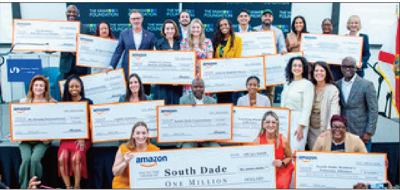
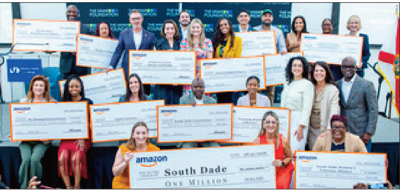
The event, held in partnership with Amazon, also included the announcement of approximately $1 million in new funding, with 13 South Dade-serving nonprofit organizations receiving $75,000 each.
Commissioned by a group of South Florida funders, the two-phase study examined more than 1,400 grants made to 262 nonprofits between January 2023 and October 2024. Researchers analyzed approximately $94 million in funding from participating public and private funders.
Approximately 77% came from public dollars, compared with 23% from private sources, leaving South Dade organizations particularly vulnerable to changes in government budgets and priorities. Among organizations for which additional financial information was available, 34% relied on government sources for more than half of their annual budgets.
Funding was concentrated in a small number of service areas. Youth and family services accounted for approximately 64% of funding, followed by health at 19% and education at 9%. Economic mobility, the arts and environmental initiatives received considerably smaller shares.
The report also identified significant geographic disparities. More than 66% of the funding studied flowed to Homestead and Florida City, where a larger concentration of nonprofit organizations is located.
Higher-poverty unincorporated communities including West Perrine, Goulds, South Miami Heights, Naranja, Leisure City, Richmond Heights, Richmond West and Princeton generally received fewer grant dollars overall and per resident.
That distinction is particularly important in South Dade, where municipal boundaries do not always reflect the way residents experience the region. While Homestead, Florida City, Cutler Bay and Palmetto Bay have established municipal governments and civic infrastructure, large portions of South Dade remain unincorporated. Many of those communities face some of the region's highest levels of need while receiving comparatively less philanthropic investment.
The challenge is not simply how much money reaches South Dade, but also what organizations are able to do with it.
Only 4% of the funding analyzed was flexible or unrestricted, such as general operating or capacity-building support, while just 1.7% went toward capital improvements. Seventy-one percent of organizations received funding from only one participating funder.
The report found that smaller, community-based organizations often operate with limited budgets and infrastructure, while larger organizations and nonprofits headquartered outside South Dade tend to attract a disproportionate share of grant funding.
Researchers paired the funding analysis with interviews involving 19 South Dade leaders, service providers and advocates. Housing affordability was the most frequently identified community concern, followed by transportation, mental health services, workforce training and postsecondary pathways, services for older adults and healthcare access.
Transportation emerged as a recurring barrier, particularly in unincorporated areas where public transit and services may be limited or geographically dispersed. The report also found insufficient pathways connecting residents to high-growth, higher-paying careers, forcing some workers to travel significant distances for employment.
At the same time, the study highlighted areas of progress, including expanded bus routes, additional primary and urgent-care facilities and collaborations such as the South Dade Cares Coalition, Richmond Heights Community Alliance and Goulds Coalition of Ministers and Lay People.
The report offers five broad areas for action: increasing flexible and private funding for grassroots organizations, bringing services directly into underserved communities, developing South Dade's next generation of leaders, improving awareness of existing services and strategically investing in housing, healthcare, workforce development and postsecondary opportunities.
Monday's Amazon announcement represents one immediate private-sector response to those findings. But the report's larger message extends beyond any single grant announcement.
South Dade is no longer simply the distant edge of Miami-Dade County. It is home to some of the county's fastest-growing communities, and the study suggests that meeting that growth will require strengthening the organizations, institutions and community networks residents depend on as the region continues to change.
The report cautions that the $94 million analyzed does not represent every dollar invested in South Dade. Some countywide funding, donor-advised gifts and funding from organizations outside the study were not captured, and the authors note that some figures are estimates.
Still, taken together, the data and community interviews offer something South Dade has often lacked: a clearer picture of not only where the region is growing, but where its capacity to support that growth remains uneven.
PHOTO CAPTION:
The Miami Foundation hosted local leaders and South Florida nonprofits at an event August 1, where Amazon surprised each organization with a $75,000 donation. The $1 million in donations is to help nonprofits uplift and connect with the needs of residents in unincorporated South Dade communities, such as Leisure City, Naranja, Goulds and more

(0) comments
Welcome to the discussion.
Log In
Keep it Clean. Please avoid obscene, vulgar, lewd, racist or sexually-oriented language.
PLEASE TURN OFF YOUR CAPS LOCK.
Don't Threaten. Threats of harming another person will not be tolerated.
Be Truthful. Don't knowingly lie about anyone or anything.
Be Nice. No racism, sexism or any sort of -ism that is degrading to another person.
Be Proactive. Use the 'Report' link on each comment to let us know of abusive posts.
Share with Us. We'd love to hear eyewitness accounts, the history behind an article.