
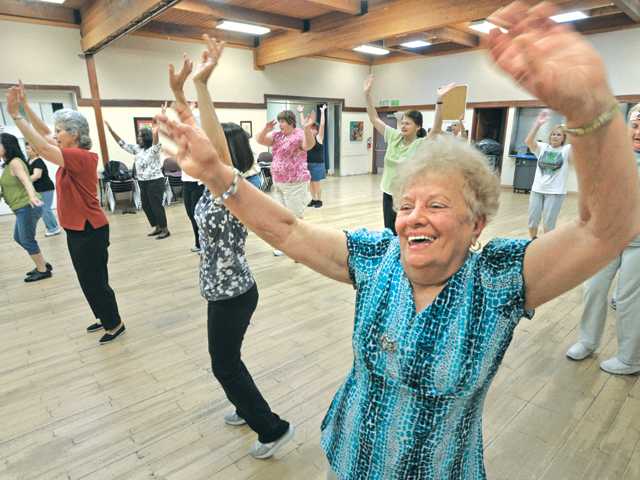
Barbara Arbani laced up her sneakers and began sashaying to the sound of salsa music while pumping her arms to the beat.
“The dancing and the music keep my mind active and my body working,” Arbani said minutes after she finished taking a Zumba dance class.
Arbani turned 65 this year, and exercise is just one way she celebrates life.
“I see it as a beginning,” said Arbani, a former restaurant owner. “Aging is about enhancing your life. You finally have the resources to do it. And I retired, finally.”
Arbani and so many other active older adults defy myths that aging slows people down. Her schedule is packed with dates with her grandchildren, travel, exercise classes and hiking adventures.
“I don’t feel old at all; I think 65 is just a number,” she said. “I’m older than each of my parents when they passed away. I always feel each year is a gift — rather than thinking, ‘My gosh’ I’m getting old.’ ”
For some older folks, she said, it may be tough to get up ready and “push themselves to get out there and join something.”
“People can get isolated so easily,” she said. “But I know two women who are 90, widows, but they get out there and dance. They are examples and inspirations for all of us.”
Dick Goldberg, national Director of Coming of Age, a national initiative to promote civic engagement for those who are 50 and older, said Arbani’s attitude is an “assets-based” approach to aging.
“You have to look at all your assets instead of your liabilities,” he said. “We encourage people to take a realistic view of life, but sometimes assets get marginalized and people will focus on the negative instead of positives.”
When he spoke at The International Conference on Positive Aging in Sarasota, Fla., he emphasized his motto: “Old is Good.”
His group is working with several agencies on aging across the nation to encourage seniors to embrace some positive aging ideas and their rich potential.
“What do we do with all this energy and expertise? How do we capture it? How do we take a source — people 50 years and older — and transform it into a force ... for social good and dynamic personal growth,” Goldberg asked.
First on the agenda: combating ageism. He said baby boomers (people born between 1946 and 1964) resist using words such as older, senior and aging.
“Bottom line, our culture simply does not have a way of talking about the largest demographic wave to hit the United States in over a century. I like the term the ‘new old,’” he said. “But whoever we are, many of us envision a future that’s quite different from the traditional model of retirement as a time of leisure.”
Goldberg pointed to a recent Merrill-Lynch survey that shows 75 percent of baby boomers say they intend to land a job after they leave their primary career. Another segment, it reports, plans to “un-retire,” heading to work in another field for a host of reasons, including the need for income, a challenge or the search for meaning, he said.
“Many of us will experiment or cycle, seeking to balance work and play; spending and earning; connecting and contributing to help society on one hand, and on the other hand, seeking ways to become more of who we know in our souls we are mean to be,” he said.
Combating ageism should move to the top of the “positive aging agenda,” Goldberg said.
“The way some older people have been seen in this county is inaccurate,” he said. “You see images of people who can’t remember things, people who lost bodily functions, and people who confused. Sure that applies to some people with a problem or an illness, but it doesn’t apply to most older people.”
Mel Berman, 73, crunched numbers for decades as an actuary in the insurance industry. In retirement, he’s Elvis or Mel Torme. Maybe even Frank Sinatra.
Berman has a singing voice that has earned him comparisons to the latter two. He dressed up as The King and sang “It’s Now or Never” at his condo community’s Halloween party. And he’s the only non-resident invited to perform in another retirement home’s annual musical revue.
“People tell me I have a very nice voice,” he said. “I think my voice got better as I got older.”
Berman allowed his creativity to blossom by making YouTube video parodies of pop tunes such as “The Gambler,” which he adapted as “The Golfer,” in honor of another of his favorite pastimes. (“You gotta know when to putt ’em, know when to chip ’em ... ”)
Carol Kulik, 73, said she never lived alone and “never went anywhere” before she was 62. Now she travels all the time.
She has taken cruises, visited Alaska, and regularly joins a friend for road trips. Kulik also jumped at the opportunity that retirement gave her to volunteer at her church.
“God put me on this Earth to help other people,” she said. “I didn’t have time to do that while I was raising kids and divorcing two husbands, “ she said. “Until my money or my legs give out, I’m gonna keep on going. I love retirement. Ninety-nine percent of it is good.”
Busy as Kulik’s travel schedule is, it doesn’t approach the wanderings of Dick and Jane Braun of Northampton, Pa., who are in their early 70s.
“We do a reasonable trip, two to three times a year, domestic and foreign, either way,” said Braun.
Recently, the Brauns joined Dick’s brother and his wife for a spur-of-the-moment week in South Florida, their third trip to the Sunshine State in a year.
But most of the time, they carefully plan their travel. They have a set of friends with whom they go abroad, and another group they accompany around the United States. Over the years, they’ve been to China, Canada, the Czech Republic, Germany, France, Poland, Italy and Tibet. The couple also has explored the northwestern U.S., Yellowstone National Park, the Grand Tetons, North Carolina, Nova Scotia and most points in between.
“We haven’t been to every state. That was my goal years ago, but I don’t think so (now),” said Jane Braun.
The best part of travel is discovering another region, culture or cuisine, she said.
“I think that you get to see a lot of diversity, with various peoples,” she said. “You learn some of their customs, their foods. In particular, when we went to China, there was quite a variation in foods, quite different from what I recognize as Chinese food.
“We stayed with a Chinese family overnight (in China), so we got to see the inside of their home, and we had dinner with them,” she added. “They took us out into a courtyard, and they had music, and they wanted (the guests) all to dance. So we were doing the Hokey Pokey in China.”
Her husband said they plan to go to Aruba in July, with perhaps another trip in the fall.
“You have to do it while you’re still able,” he said.

(0) comments
Welcome to the discussion.
Log In
Keep it Clean. Please avoid obscene, vulgar, lewd, racist or sexually-oriented language.
PLEASE TURN OFF YOUR CAPS LOCK.
Don't Threaten. Threats of harming another person will not be tolerated.
Be Truthful. Don't knowingly lie about anyone or anything.
Be Nice. No racism, sexism or any sort of -ism that is degrading to another person.
Be Proactive. Use the 'Report' link on each comment to let us know of abusive posts.
Share with Us. We'd love to hear eyewitness accounts, the history behind an article.