
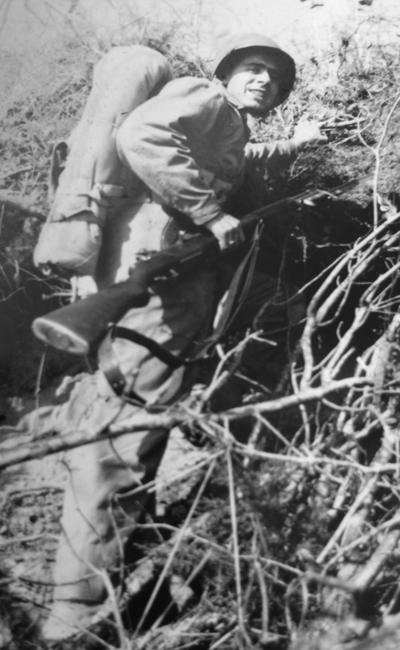
“Thank God, the good Lord was looking after me”, recalled World War II veteran Anthony “Tony” Verzi on his surviving the Invasion and Battle of Okinawa between April 1st and June 21st, 1945. Mr. Verzi was part of a generation of Americans whose service helped to liberate Europe from the German Reich and Asia from the Japanese Empire in the 1940s. Hailed as “the Greatest Generation” by Tom Brokaw’s biographies of United States Armed Forces service members, sixteen million Americans placed their lives at risk during World War II. Mr. Verzi was part of U.S. occupying forces in Japan following the War’s end in August 1945, and in December of that year served in Northern China as American troops tried to assist Chinese Nationalist troops in their attempt to defend mainland China from Chinese Communist forces.
During interviews, with a greatly apparent deep sense of humility and modesty Mr. Verzi shared his recollections on his service during World War II’s Pacific War and on his times as a founding Knight of Columbus at Sacred Heart Roman Catholic Church, Homestead. The son of Sicilian Italian-American immigrants who first worked in America’s textile mills, Mr. Verzi’s thoughts on a lifetime that has taken him from his hometown of Lawrence, Massachusetts to Earth’s far reaches provide invaluable insights on American troops’ role in America and the planet over the past ninety years.
Mr. Verzi made it clear that he feels that he doesn’t deserve the notoriety that he’s received since celebrating his 90th birthday in June. A birthday highlighted by a U.S. Marine Corps service member’s presentation to him of an American flag flown at the Pentagon. As he stated, his service in the military was “part of doing the job”.
“I didn’t know where Pearl Harbor was. When I listened to the president on the radio then I realized that we had been attacked”, Mr. Verzi recalled when he first learned of the Imperial Japanese Navy fighter planes attack on Pearl Harbor, Hawaii on December 7th, 1941. At the time, Mr. Verzi was in high school living with his parents in Washington, DC where his father had taken a job in 1938.
In 1943 Mr. Verzi began his service in the Marine Corps where he achieved the rank of sergeant. He completed basic training at Parris Island, South Carolina in September 1943. Subsequently he trained as a radio operator at Camp Lejeune, North Carolina before going overseas to GuadacanalIsland in the Pacific from August 1944 to March 1945 in preparation for the Invasion of Okinawa on Easter Sunday, April 1st, 1945.
In the Invasion, Mr. Verzi served in the Corps 6th Marine Division, 29th Regiment. For “Superior Performance” at Okinawa, the 6th Marine Division received a Presidential Unit Citation. Called the “bloodiest battle of the Pacific War” by historian William Manchester, over eighty two days of fighting 12,500 American troops died or went missing, and 38,000 Americans were wounded. Additionally, about 110,000 Japanese soldiers were killed at Okinawa. As he described the struggle to control Okinawa’s Sugarloaf Hill, Verzi explained how the Japanese soldiers hid in the hill’s caves.
With detail on his war service, Verzi recalled: “The things that impressed me the most is that when we got to Japan, the people there were starving. They would eat off our garbage pales – the same thing in China; terrible conditions.” In expressing a sense of human sympathy for Japanese civilians of the World War II years, Mr. Verzi noted, “the Japanese people were so brainwashed by their leaders that they didn’t deserve to be in those conditions.” In referring to the American bombing of the Japanese capital city, he remembers that, “there was nothing left over but ashes in Tokyo.”
As to his military duty, in a soft spoken tone, he stated, “we focused on getting our mission done”. When he first heard that Japan had surrendered and that World War II was over, he said, “we were very happy to hear that the war was over and that we would be going home soon”.
At World War II’s conclusion, Mr. Verzi went back to Washington, DC and along with his parents eventually returned to LawrenceMassachusetts where as his wife Lucille recalled, “he got a job at the Boston Navy Yard”.
In 1954, Mr. Verzi began his sixty year affiliation with the Knights of Columbus, a fraternal organization for Roman Catholic men.
“I had a close friend and he asked me to join”.
Married in 1952, in 1956, Anthony and Lucille Verzi moved to FloridaCity. In 1964 they relocated to the Redland home that they live in today. In 1960 he was a founder of the Sacred Heart Catholic Knights of Columbus Council. A 3rd and 4th Degree Knight, he’s the last survivor of the 33 founding knights, remaining active in the organization where he currently serves as a trustee.
“The Knights of Columbus has helped me a lot with my religion. It’s helped me be a better Catholic.”
Mrs. Verzi joined in, saying that the group was about, “lifelong friendships”. Commenting on her husband, she added “I’m very proud of Tony, everything he’s done for the Knights and his dedication to family an friends”.
1950s Homestead and South Dade were far different from today’s growing suburban communities.
“When we first moved down here U.S. 1 was a two lane highway. I could leave Homestead in the morning to go to the airport (Miami International where he worked for 30 years at Eastern Airlines) and not hit a traffic light until I got to South Miami. There was practically nothing, except for farms along U.S. 1 between Homestead and South Miami.”
Verzi reminisced about Breeding’s Drug Store (a business at the time located in today’s Homestead Historic District) was “where everyone in Homestead met for coffee.” While he worked at MIA, his wife “was a nurse and she first went to work to the original HomesteadHospital.”
As he proceeds in his life’s ninth decade, Mr. Verzi expressed on his legacy to his descendants (four children, nine grandchildren, 5 great-grandchildren with 3 more great-grandchildren on their way to being both), stating, “I hope that they can live the type of life that I’ve had. I’m ninety years old and still going. I don’t feel my age at all.” As she sat next to her husband in their home’s dining room, Mrs. Verzi summarized their lives’ philosophy to the present day as “Believe in God, be in love and eat good”.
Verzi wears a ‘miraculous medal’ given to him in 1943 by his sister’s catholic high school’s mother superior. The medal’s inscription, ‘Queen of Peace lead us to victory and safely home’ is a fitting invocation to Mary, the mother of Jesus, for America’s soldiers who in the1940s left their communities to defend their nation’s sovereignty, save millions of people from two oppressive empires and returned home to make America a beacon of hope for humanity.

(0) comments
Welcome to the discussion.
Log In
Keep it Clean. Please avoid obscene, vulgar, lewd, racist or sexually-oriented language.
PLEASE TURN OFF YOUR CAPS LOCK.
Don't Threaten. Threats of harming another person will not be tolerated.
Be Truthful. Don't knowingly lie about anyone or anything.
Be Nice. No racism, sexism or any sort of -ism that is degrading to another person.
Be Proactive. Use the 'Report' link on each comment to let us know of abusive posts.
Share with Us. We'd love to hear eyewitness accounts, the history behind an article.