
In a recent South Dade News Leader opinion piece, Dr. Rose Martin argued that nonprofit organizations are more than charitable service providers.
They are part of a community’s civic infrastructure, building relationships, developing leaders, mobilizing volunteers and helping communities respond to problems before they become crises.
That argument applies just as strongly to the relationship between sports, volunteerism, family life and youth development.
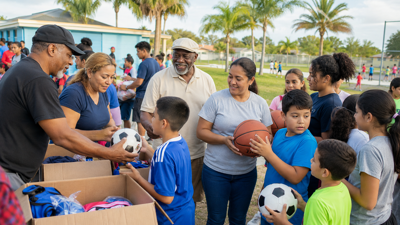
Sports organizations are usually measured by wins, championships, attendance and television audiences. Their community impact is harder to place in a standings column. It appears in free youth clinics, volunteer coaches, mentoring programs, scholarships, donated equipment and opportunities given to children who might otherwise be priced out of organized sports.
For South Dade families, access to those opportunities cannot be taken for granted. Communication is essential.
Registration fees, uniforms, equipment, transportation and travel expenses can quickly make participation difficult for lower-income households. Even programs advertised as free may remain inaccessible if families do not know they exist, cannot reach them or learn about them after registration has closed.
That is why the newspaper has begun expanding its relationships with professional sports organizations, college athletic departments, public schools and local youth leagues.
The goal is not simply to obtain game credentials or receive scores. It is to establish direct communication, open doors and build relationships with the organizations operating youth programs, charitable foundations, sports clinics, educational initiatives and community events throughout South Florida.
The Miami HEAT has agreed to add the newspaper to its community events media distribution list. That connection will allow local coverage to better identify programs that may benefit residents in Homestead, Florida City, Cutler Bay, Redland, surrounding South Dade communities and the Upper Keys.
The significance reaches far beyond basketball.
Established in 1997, the Miami HEAT Charitable Fund supports youth programs, education, health and wellness initiatives. According to the organization, Miami HEAT youth basketball programs have reached more than 357,000 participants through over 1,500 clinics.
The organization also reports donating more than 229,000 school supplies, providing more than 68,000 staff volunteer hours and distributing more than 85,000 tickets to charitable organizations.
The HEAT’s educational programs include after-school academic support, mentoring, Learn and Play Centers and scholarships available to qualifying high school seniors in Miami-Dade, Broward, Monroe and Palm Beach counties. One of its Learn and Play Centers is located at the South Dade YMCA Family Center.
Those details matter locally. A scholarship open to a student in Homestead is only useful if that student knows about it. A youth clinic cannot serve children in Florida City if their parents never receive the registration information. A nonprofit cannot request tickets, equipment or assistance if its leaders do not know the opportunity exists.
The newspaper has also opened communication with Inter Miami CF, the Miami Marlins, Miami Dolphins, Florida Panthers and other regional sports organizations. Inter Miami CF II and Academy communications have confirmed that the newspaper will be added to their distribution list and considered for future coverage opportunities.
These organizations operate or support programs extending well beyond professional competition.
The Inter Miami CF Foundation uses soccer to support education and empowerment for children and young adults in underserved communities. The foundation recently participated in an event serving 22 children from the Florida City Razorbacks Academy, a youth organization working to make sports participation available to children from underserved families.
The Miami Marlins Foundation focuses on youth baseball and softball, wellness, academic success and leadership development. Its community offerings include developmental field days, educational resources, coaching programs and complimentary ticket opportunities for qualifying nonprofits and community groups.
The Miami Dolphins’ community work includes youth football, educational programming, food relief and Football UNITES, an initiative that brings young people and community partners together through leadership development and cultural education.
When major organizations communicate with established local groups, both sides bring something necessary. Professional teams have name recognition, funding, facilities and the ability to draw attention. Local leagues, schools, churches and nonprofits understand the children, families and neighborhoods being served.
The most effective community work happens when those resources meet.
South Dade’s history is rich with volunteerism that has long supported youth sports. Before foundations developed formal initiatives and professional teams built community departments, local programs depended on parents, coaches, teachers and residents willing to organize practices, maintain fields, transport children and keep leagues operating.
It was truly a community undertaking.
Those volunteers did more than teach children how to shoot a basketball, field a ground ball or run a route. They provided structure, supervision, positive adult relationships and somewhere productive for children to go after school.
For lower-income families, that support can carry additional weight. Organized sports can provide physical activity, mentorship, academic expectations, leadership experience and exposure to educational or career opportunities.
Volunteer coaches and community organizations frequently become the people who recognize when a child needs equipment, transportation, tutoring or simply another adult paying attention.
A healthy community is built across generations.
Older residents preserve the history of how neighborhoods survived, organized and grew. Adults turn that knowledge into service, institutions and opportunities. Children inherit not only the programs created for them, but also an understanding that they will one day have a responsibility to strengthen the community for the generation that follows.
Connecting the wisdom of age with the energy of adults and the growth of children helps create the fabric of a community that understands where it came from and communicates where it hopes to go.
That history of service is not separate from South Dade’s broader nonprofit history.
In 1971, community advocate Doris Ison worked with churches, residents and volunteer physicians to address the lack of healthcare available to Black residents, migrant farmworkers and low-income families in southern Miami-Dade County.
Community Health of South Florida Inc. began in two trailers near Southwest 216th Street and eventually developed into a lasting regional healthcare system.
Following Hurricane Andrew in 1992, local volunteers worked alongside national organizations to distribute food, operate shelters and rebuild homes. The American Red Cross response included more than 14,000 workers, most of them volunteers. Habitat for Humanity of Greater Miami eventually constructed nearly 200 homes for families displaced by the storm, including more than 40 in Goulds.
The programs were different, but the lesson remains the same: community improvement is strongest when local knowledge communicates with larger resources.
Dr. Martin’s argument also points toward a newspaper’s responsibility within that system. Nonprofits, charitable foundations and youth programs cannot build support when their work remains invisible. Families cannot use resources they never hear about. Volunteers cannot answer needs that have never been clearly communicated.
The newspaper’s expanding sports outreach is intended to close part of that information gap.
Coverage will continue to include games, athletes and competition. It will also communicate scholarship deadlines, youth clinics, community appearances, volunteer opportunities, equipment distributions, nonprofit partnerships and programs available to local children and families.
The same principle is guiding Helping Hands of South Dade, the newspaper’s developing nonprofit section.
The purpose is not to publish promotional profiles. It is to explain what organizations do, whom they serve, what assistance is available and how residents can become involved.
That distinction matters.
A newspaper should not merely announce that an organization is doing good work. It should determine where the work is happening, who can participate, what barriers remain and whether the people most likely to benefit are being reached.
South Dade already has children eager to play, parents trying to create opportunities, elders willing to share their experience and volunteers ready to serve. It also has professional teams, foundations and nonprofit organizations with programs designed to help.
The missing piece is often communication.
By building stronger lines of communication between those institutions and the communities the newspaper serves, regional opportunities do not have to stop somewhere north of South Dade.
A child should not miss a clinic, scholarship or mentoring program simply because no one made sure the information reached that child’s neighborhood.

(0) comments
Welcome to the discussion.
Log In
Keep it Clean. Please avoid obscene, vulgar, lewd, racist or sexually-oriented language.
PLEASE TURN OFF YOUR CAPS LOCK.
Don't Threaten. Threats of harming another person will not be tolerated.
Be Truthful. Don't knowingly lie about anyone or anything.
Be Nice. No racism, sexism or any sort of -ism that is degrading to another person.
Be Proactive. Use the 'Report' link on each comment to let us know of abusive posts.
Share with Us. We'd love to hear eyewitness accounts, the history behind an article.