
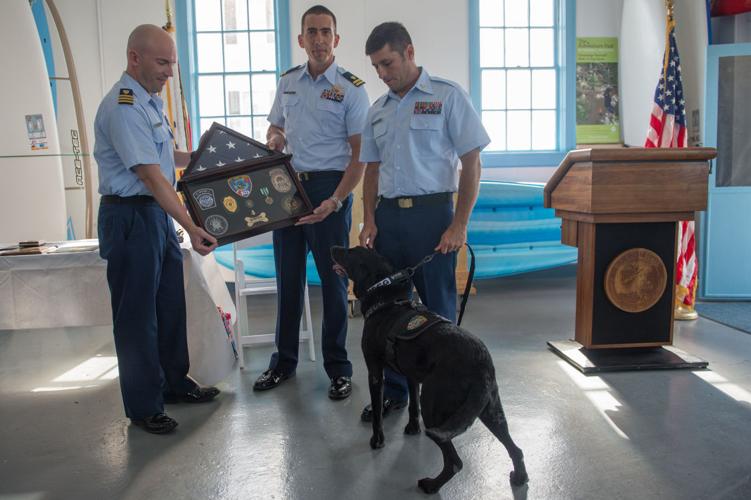
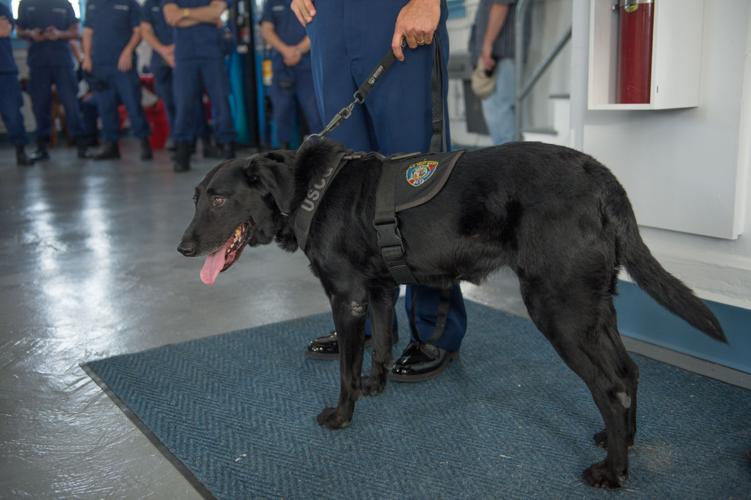
Every dog has its day, and for Chief Sirius, a Coast Guard K9 explosive detection dog, it was May 15. The day marked the culmination of six years of dedication and deployments as a working K9 for the Coast Guard.
Chief Sirius retired with full honors and standing by her side just as he has for six years was her handler,Coast Guard Petty Officer 1stClass Joseph R. Tokarksy. Tokarsky, who has been in the Coast Guard for 18 years, will remain in the service, but when he returns to work following the retirement, he will return empty handed, leash and K9 not in hand.
"I think I might have a harder time with this transition than Sirius," Tokarsky said. "Sirius is going to make a great lap dog. It won't be difficult for her to make the work-to-home transition."
Tokarsky, now a maritime enforcement specialist stationed at Coast Guard Maritime Security Response Team Chesapeake, Virginia, hasn't always been a K9 handler. When the Coast Guard initially introduced the K9 program, he was a gunners mate, stationed at Maritime Safety Security Team Galveston, Texas. In order to apply to be a K9 handler, Tokarsky, like all Coast Guard K9 handlers, had to transfer to the maritime enforcement specialist rating. In 2008, Tokarsky was transferred to MSST Kings Bay, Georgia, where he was accepted into the program. He entered the programin April 2009 at the U.S. Customs and Border Protection K9 School in Front Royal, Virginia, and graduated from the course in July 2009.
During the third week of training, prospective K9 handlers receive their dogs. Sirius, a female black Labrador, wasn't Tokarsky's initial partner, though. Initially, he was given two dogs, both Belgian Malinois: a male named Jimbo, and a female named Norje.
"For one reason or another, neither Jimbo nor Norje didn't make the cut," Tokarsky said. "In CBP, they evaluate the handler and the dog separately. The instructors want to see how we progress independently before we are partnered."
Tokarsky worked with Jimbo and Norje until close to graduation, but when the dogs did not pass the final screening, he was without a partner. Instead, the instructors partnered Tokarsky with a male black Labradorretriever named Skeet. He and Skeet left the school and returned to MSST Kings Bay until Sirius was ready for Tokarsky. Six months after graduation, Tokarsky returned to the school to return Skeet and pick up Sirius.
"I was nervous because I had never worked with her," Tokarsky said. "I didn't have the opportunity to bond with her. I was already certified as a dog handler, but I had to go back and qualify with Sirius, and I didn't want to fail. I didn't want to let my command down."
Sirius came with a back story: At 5 years old, she was a field-return dog, which meant she was already in service with CBP for two years. Once CBP dismantled its K9 explosive detection school, all explosive detection dogs were returned to the training facility and adopted out to other agencies or to civilians. Sirius was one of the dogs who still showed the ability to work, so she was adopted out to the Coast Guard's K9 program.
On their first meeting, Tokarsky observed Sirius to be easy going and laid back - toward humans, Tokarsky said. Because he had been previously partnered with a black lab, he was acclimated to the Labrador personality.Labradors are bird dogs, and Sirius has the potential to get easily distracted, while training or during missions, by birds. Tokarsky recognized and adapted to her unique traits early on, and they have been the perfect match since the beginning of their partnership.
When it comes to other dogs, she has a different side to her personality.
"She has the potential to be dog-aggressive," Tokarsky said. "She doesn't like other dogs, but a lot of that is due to the acclimation process. As trained K9s, they are segregated from the beginning of the training, so they don't get a lot interaction with other dogs."
After Tokarsky qualified with Sirius, he and his partner returned to MSST Kings Bay where Sirius was integrated into the Coast Guard mission and lifestyle.
While at MSST Kings Bay, Tokarsky and Sirius covered thousands of miles in support of Coast Guard missions. As partners, the pair was responsible for sweeping, also known as clearing, areas being visited by high-profile political figures such as the commandant of the Coast Guard and president of the United States. Together, Tokarsky and Sirius have driven more than 66,800 miles to complete training and support missions, and have flown more than 7,300 miles in support of Coast Guard operations.
When it comes to air travel, Coast Guard K9s receive the royal treatment: They have special permission to fly aboard the aircraft, as opposed to below the passenger deck as cargo. They are trained to hold their bladders for the duration of the of travel.
"Sirius does great when it comes to flying," Tokarsky said. "We would ask for an aisle seat, and if that wasn't available we would book the seat directly behind the first class cabin because there was more leg room. Sirius would just lie on the floor."
Tokarsky recalled one encounter with a fellow passenger, who praised the dog's good behavior.
"We were getting off a flight and a man came up to me and said, 'man, that dog was better behaved than some people who fly,'" Tokarsky said.
Sirius' good behavior and astute bomb detection abilities are both a credit to Tokarsky's handling capabilities and Sirius' skills as an explosive detection K9. Tokarsky credits this to the constant training he and other Coast Guard handlersparticipate in with various other government agencies. Tokarsky has worked with agencies such as Alcohol, Tobacco and Firearms; Federal Protective Service; CBP; and the Transportation and Security Administration.
"Interagency partnerships are crucial to the success of the Coast Guard's K9 program," Tokarsky said. "We work with federal state and local agencies. This program is such a benefit for the Coast Guard in the sense that we strengthen our relationships with other agencies. When other agencies need us, they have us on speed dial and they call the handlers first."
Knowing that his number is on speed dial, Tokarsky finds that constant training is the key to having a successful handler/K9 relationship. He prides himself on a motto that was a part of his training in Front Royal: What you allow a dog to do is what you train a dog to do.
Coast Guard Petty Officer 1st Class Chris Hartman, a maritime enforcement specialist, and fellow K9 handler to Evy an 8-year-old Belgian Malinois, worked with Tokarsky and Sirius while the pair was stationed at MSST San Francisco. In the time they were stationed together, Tokarsky and Hartman were responsible for patrolling, with their K9 counterparts, the San Francisco ferry system.
Hartman explained that the ferry system moves approximately 10,000 people per day. Part of the Coast Guard's mission is ports, waterways and coastal security. The Coast Guard K9 program provides an invaluable service via the K9 program by sweeping the ferry for explosives.
"It's a unique skillset that we have," Hartman said. "We provide an asset, which is a scarce resource. "We have real good dogs, trained to do a lot of things. You can't force a dog to do this. The dog has to want to do this job, and Sirius had that drive."
At almost 11 years old, Sirius may be watching the sun set on her explosive detection days, but there are brighter retirement days ahead for this esteemed K9.
Tokarsky will adopt Sirius after her retirement and fully integrate her into his family, which includes his wife,Misti, and their three children.
"Sirius is great with my children, especially my son," Tokarsky said. "He calls her, 'my Sirius.' Sometimes I have to watch him with her. I have taught him to be mindful of her and respect her boundaries, but they love one another; they have a bond going on."
Sirius will continue to enjoy the rest of her dog days in the Tokarsky household, surrounded by the love of her adopted family. The gray fur that has started peeking through her shiny black coat isn't a sign of old age; the fur is more like service stripes earned after a career of hard work, dedication and service to the Coast Guard.
"When I put her in the truck and then open the door to let her out, she knows it is time to work," Tokarsky said. "It's going to be difficult because we've been a team for so long and we are so used to our routine and what we do together: She is used to coming to work with me every day, and I am used to going to work her every day. Now, things will change."

(0) comments
Welcome to the discussion.
Log In
Keep it Clean. Please avoid obscene, vulgar, lewd, racist or sexually-oriented language.
PLEASE TURN OFF YOUR CAPS LOCK.
Don't Threaten. Threats of harming another person will not be tolerated.
Be Truthful. Don't knowingly lie about anyone or anything.
Be Nice. No racism, sexism or any sort of -ism that is degrading to another person.
Be Proactive. Use the 'Report' link on each comment to let us know of abusive posts.
Share with Us. We'd love to hear eyewitness accounts, the history behind an article.