

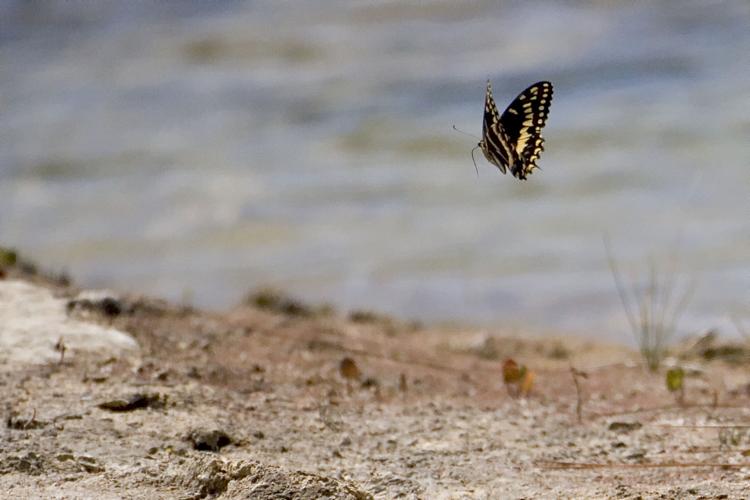

Before we become enveloped in mosquito season, spring can be a great time to observe the beautiful flying insects of Everglades National Park. Butterflies are in flight most of the year, moths are most abundant from March until late spring when they taper off as the rains increase and dragonflies are just now starting to appear.
The Fascinating Moth
Moth species were inventoried from 2009-2014, by Carol Wolf, a park volunteer. She went to popular visitor sites such as Royal Palm, Mahogany Hammock and Flamingo. Surprisingly, she counted 414 different species. For the most part, the number of moths in the park had gone unnoticed until Wolf counted them. The main reason moths had not been widely inventoried was that the creatures tend to come out at night, like moths elsewhere, when most park staff members are off duty. This is a great example of how much the park is helped by volunteer citizen scientists.
Fortunately, the park does not have any threatened or endangered moth species or documentations of a non-native species. More study is needed to learn which moth species may have a range that extends to the tropics. We suspect that quite a number of them do.
The moths local residents see flitting about their porch lights and street lamps appear to be different species from those seen in the Everglades. The moths found in the park seem to be those that prefer the quiet environments provided by the wilderness.
There is less known about the habitats moths prefer in general, but from what Wolf found, the moths in the park range from the nearly translucent satin white palpita, the oddly named but beautiful pale blue bird-dropping moth, the bright scarlet-bodied wasp moth and the Zale viridans species group that has yet to be given a common name.
The Incredible Dragonfly
Figuring out how many and which dragonfly species there are in the park has a longer history than that of butterflies or moths. Generally, it is believed the inventory of approximately 65 dragonfly species completed by Doug Paulson for his University of Miami doctorate in 1966 was the most accurate and is still referred to as such.
In the early 2000's, the U.S. Geological Survey of the Northern Prairie Wildlife Region in North Dakota inventoried dragonflies in the Miami-Dade area. They did not add any additional species, which was good because as of today, no non-native dragonflies have been documented. There are also no known threatened and endangered species of dragonflies in the park.
Raul Urgelles of the NPS South Florida/Caribbean Network advises that dragonflies are an important component of the Everglades food webs. His research also shows that a dragonfly's complex life cycle creates a link between wetlands during its larval stage (aquatic) and can have subsequent effects on terrestrial food-web dynamics when it becomes an adult. Urgelles' other findings indicate that "dragonflies may not necessarily be the best indicators of water quality, but they can be indicators of changes in hydrology."
Dragonflies inspire many visitors because of their surreal iridescent head, large eyes and elongated thin body. They can be found in practically all parts of the park, from the prairies to the deep sloughs and to the coastal areas. What is challenging about viewing dragonflies is that they move so quickly, an attribute that is apparent in their common names: the garnet glider, spot-tailed dasher and the swift setwing.
The colorful butterfly
With 170 species, Florida is commonly recognized as having the most diversity of butterflies of any state east of the Mississippi. That may sound like a lot, but the drier western states of the United States have at least that many and many more. The Everglades can boast of approximately 98 species, which is actually pretty impressive given that the majority of the park is either covered by water during rainy season or covered by water year-round.
Butterflies don't mind water so much as long as there are pollinating flowering plants available and a safe, dry place for their caterpillars to hang their cocoon. Examples of butterflies that brave the swamps are skippers, which are actually in their own family of butterflies called Hesperiidae. These include the delicate orange, black-and-tan Aaron's skipper; the more mellow brown-and-orange Berry's skipper; and bright yellow-and-orange Delaware skipper.
Most of the park's butterflies can be found in coastal environments. Other than the federally threatened ceraunus blue, the three other federally protected butterflies in the park are exceptions. This includes the Florida leafwing butterfly, Miami blue, and cassius blue that prefer pinelands, tropical hammock edges or dry scrub and sometimes roadsides.
The leaf wing's status is noteworthy. "The endangered Florida leafwing is endemic to southern Florida, occurring within pine rockland habitat that retains its only known host plant, pineland croton," explains Mark Salvato of the US Fish and Wildlife Service." The leaf wing's historic range has diminished significantly and currently is only known to occur in the Long Pine Key region of Everglades National Park."
Salvato has studied the Florida leaf wing for over 20 years, and he has learned virtually every aspect of the delicate butterfly's natural history and ecology. He also played a key role in documenting known butterfly species in the park. In 2008, he and his wife compiled the checklist of butterfly species provided to visitors today.

(0) comments
Welcome to the discussion.
Log In
Keep it Clean. Please avoid obscene, vulgar, lewd, racist or sexually-oriented language.
PLEASE TURN OFF YOUR CAPS LOCK.
Don't Threaten. Threats of harming another person will not be tolerated.
Be Truthful. Don't knowingly lie about anyone or anything.
Be Nice. No racism, sexism or any sort of -ism that is degrading to another person.
Be Proactive. Use the 'Report' link on each comment to let us know of abusive posts.
Share with Us. We'd love to hear eyewitness accounts, the history behind an article.