
The City of Homestead is working on plans to improve Harris Field, and many residents have filled out surveys or attended meetings. But behind the familiar name is a man whose life was closely tied to the city's development.
For a look back at the man whose name appears on the signs, Bob Jensen wrote “Tom Harris Helps Shape Homestead” on Dec. 20, 2012, as part of the lead-up to Homestead's 2013 Centennial Celebration.
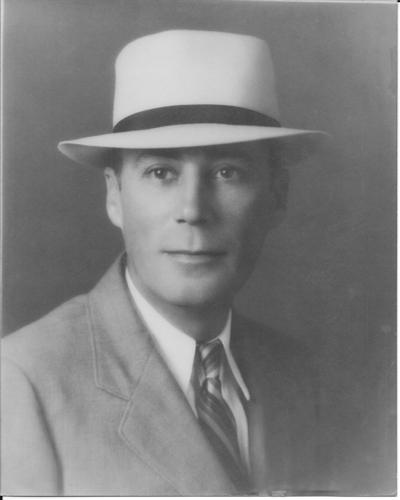
Thomas J. Harris, affectionately known as Mayor Tom, was born in Houston and came to Homestead in 1915 as a young man. He worked in the vegetable produce business and later became a significant figure in the community's agriculture, banking and municipal government.
His work also brought him to the woman he would marry.
While living in Homestead, Harris bought peaches in Georgia for Gentile Brothers. He stayed with families as he traveled around the state. In Byron, Georgia, he rented a room from the Bush family and met their daughter, Rosa.
The couple married in 1921.
Tom and Rosa lived in a small house on Ninth Street, one block east of Krome Avenue. Just days after the 1926 hurricane, their only child, Thomas J. Harris Jr., was born. Following the hurricane, the family built a home on Kings Highway at 75 NE 15th St.
For 10 years, Harris managed the Hardee & Gentile packinghouse. In 1936, he became a partner in the Hardee & Harris packinghouse along the Seaboard Railroad tracks in northwest Homestead.
According to Jensen's account, Capt. Hardee was the largest tomato grower on the East Coast, and the packinghouse was among the largest of its time. Alger Farms later used the building before Hurricane Andrew destroyed it.
Harris also served as chairman of the board of directors of the First National Bank of Homestead from 1939 to 1944.
His service as mayor spanned two periods: 1937 to 1948 and 1956 to 1961.
Community leader J.T. Godwin remembered him as a “wonderful, compassionate man, a straight shooter who was very knowledgeable of city finances.” Jensen's account also described Harris as someone able to anticipate unforeseen consequences of proposed city actions.
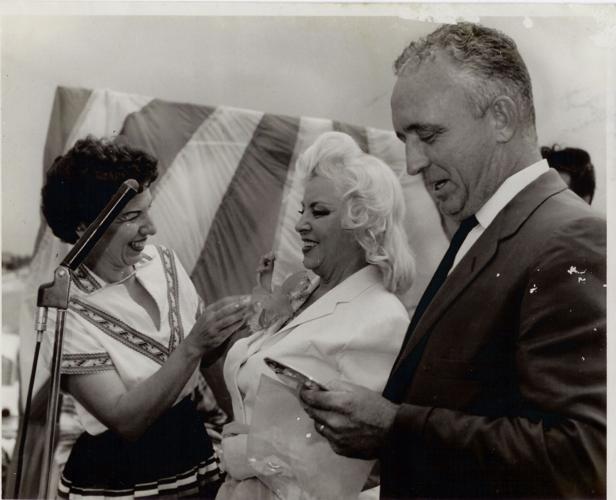
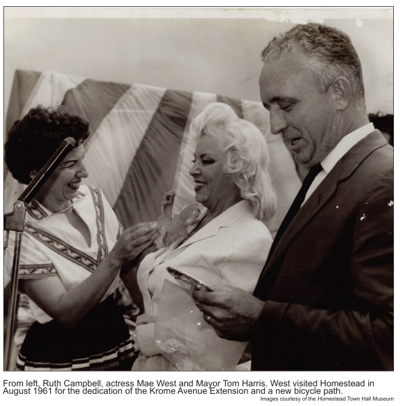
In his final year as mayor, Harris posed with actress Mae West, who visited on Aug. 21, 1961, for the dedication of the Krome Avenue Extension north of the Tamiami Trail.
Florida Gov. Farris Bryant participated in the dedication, along with West, Seminole representatives and the U.S. Air Force. Homestead was promoting itself as the “City of Bicycles,” and a new bicycle path was also dedicated during the celebration.
Harris Field was dedicated to the longtime mayor in 1960, two years after the current rodeo arena was first used for the Homestead Championship Rodeo.
His name remains part of everyday life in Homestead, even for residents who may know little about the man behind it.
More of that history can be explored at the Homestead Town Hall Museum, 41 N. Krome Ave., across from Losner Park. Its collections include photographs, articles and historical items, along with books such as “Homestead, Florida: From Railroad Boom to Sonic Boom,” by Seth Bramson and Bob Jensen, commissioned for the city's centennial.



(0) comments
Welcome to the discussion.
Log In
Keep it Clean. Please avoid obscene, vulgar, lewd, racist or sexually-oriented language.
PLEASE TURN OFF YOUR CAPS LOCK.
Don't Threaten. Threats of harming another person will not be tolerated.
Be Truthful. Don't knowingly lie about anyone or anything.
Be Nice. No racism, sexism or any sort of -ism that is degrading to another person.
Be Proactive. Use the 'Report' link on each comment to let us know of abusive posts.
Share with Us. We'd love to hear eyewitness accounts, the history behind an article.