
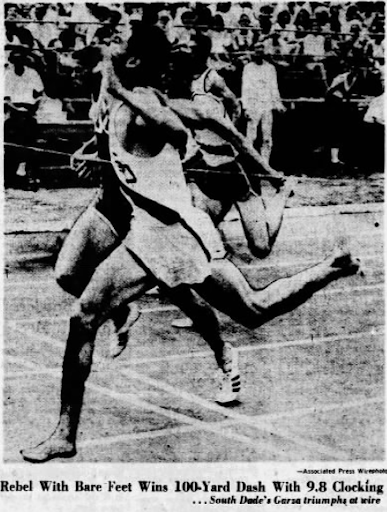
Sixty years ago, South Dade Senior High School runner Cipriano Garza Jr. covered 100 yards in 9.8 seconds and became a Florida high school state champion.
The race lasted only seconds, but the life behind it stretched across fields, classrooms, labor camps and communities that helped define South Dade.
Garza was born in Rio Hondo, Texas, and spent much of his early life following migrant farm work with his family across the United States. The family moved with the seasons, harvesting crops from state to state. His education was often interrupted as classrooms changed as frequently as fields, and stability was shaped by the demands of work and weather.
For migrant families, work was more than a job. It was a way of life shaped by long days, rainy seasons, heat, uncertainty and the constant need to keep moving. A good season could bring hope. A bad one could mean leaving again in search of work.
When the Garza family eventually settled in Homestead, his story became rooted in South Dade. At South Dade Senior High School, Garza entered a system that required consistency, something his early life had rarely allowed. Several local educators and coaches helped change the direction of his future.
Athletic Director Leo Martin encouraged Garza not to drop out of school, telling him, “Winners never quit. Quitters never win.” English teacher Mrs. Edwards helped teach him a love of reading through the novel “The House of the Seven Gables.” Track coach Norm Anderson went to the labor camp and convinced Garza’s father to let him join the track team. Another teacher discovered Garza was legally blind and helped him get eyeglasses.
Those interventions mattered. South Dade High gave Garza more than a place to attend class. It gave him structure, advocates and a track where discipline could become opportunity.
The 100-yard dash became the event that defined his athletic career. As reported at the time by the Miami Herald, Garza lined up at the Florida State Track and Field Championship under difficult circumstances. After many races throughout the season, his track shoes were worn out and torn before the final race. Replacements were not an option, so he ran barefoot.
When the race ended, Garza was a state champion. The image of a barefoot runner crossing the finish line captured attention, but the deeper meaning was clear: a student shaped by migrant farm work, Homestead and South Dade High had prepared himself for the moment and seized it.
Garza earned an athletic scholarship to Eastern Kentucky University, but after the first semester he returned to Florida. The scholarship did not include meals, and without money or a stable way to reach his still-migrating family, he made his way back to Homestead, found his family and returned to the tomato fields.
That return became another turning point. On Christmas Day, while Garza was picking tomatoes, Miami Dade College Athletic Director Dr. Bill Stokes, who had heard Garza was back in Miami, found him working in the fields and offered him a scholarship to return to the track and, more importantly, the classroom. That offer changed the course of his life.
Garza continued his track career at Miami Dade College while rebuilding his academic path. He later earned a bachelor’s degree from the University of Miami and a master’s degree from Nova University, achievements that carried added meaning for a man whose early education had been interrupted by years of migration.
Garza later turned that experience into public service for families like the one he came from. As director of the Title I Migrant Education Program within Miami-Dade County Public Schools, he helped lead efforts focused on students whose lives were shaped by migration, farm work and interrupted schooling. The work required coordination across districts, compliance with federal mandates and a sustained focus on children too often overlooked by traditional systems.
His understanding of those families was not theoretical. It came from knowing what it meant to work the fields, live with uncertainty and depend on community when stability was hard to find.
That understanding became even clearer after Hurricane Andrew.
When Andrew approached South Dade in 1992, Garza, his wife, Maria, and community members Armando and Alfredo used a local radio station to help warn residents in area labor camps to evacuate. Garza recalled working with police as they tried to reach farmworker families before the worst of the storm arrived.
“I think we saved a lot of lives,” Garza said.
He said the Everglades labor camp, which had housed thousands of people in hundreds of mobile homes, was devastated. Many of the people who left before the storm had done so after hearing warnings from the radio station and from officers who went through the camps urging residents to evacuate.
Garza also remembered the fear inside his own home. He and Maria had three young sons at the time. As the storm intensified, Armando could not make it back to his own house because of debris and destruction, so he stayed with them. At one point, Garza, Maria and Armando stood against plywood as the wind battered the house.
“There was a moment when you think, I’m going to die,” Garza recalled.
By daylight, the destruction across South Dade was clear. For farmworker families, recovery was especially difficult. Power was out across much of the area. Water was limited. Housing was scarce. Fields and agricultural structures were damaged. Work became sporadic.
Garza remembered families living in tents at Harris Field for months. He also remembered people showing up to help. Dr. Joe Greer arrived in a Jeep and asked where he could be useful. Garza said they went to the South Dade labor camp, where Greer treated injured residents throughout the day, including a young boy with a serious head wound.
Garza also recalled Carlos Gimenez, then a firefighter, arriving with other firefighters and trucks carrying food and water. Garza directed them toward the labor camp, where families needed supplies.
Andrew did not only damage buildings. It changed South Dade’s farmworker community. Garza said many workers left Florida after the storm for states such as North Carolina and Texas, and some never returned.
In the years that followed, Garza helped turn recovery into rebuilding. In collaboration with farmers, farmworkers, the business community and Dade County officials, he worked to help develop the Everglades Community Association, creating improved housing for farmworker families. He said the effort after Andrew also involved support from figures including actor Edward James Olmos and federal housing leadership through the U.S. Department of Housing and Urban Development.
His service extended beyond housing. Garza served for decades on the Community Health Incorporated board of directors and helped establish health clinics at major farm labor housing centers.
Garza also recognized that opportunity was not only academic. Cultural identity mattered, too. He co-founded the Mexican American Council and the Homestead-Miami Mariachi Conservatory, a mariachi music school dedicated to underserved children. Through that work, he helped preserve heritage while expanding access to the arts for young people in the community.
His leadership later reached the national level when he served during the Clinton administration as Special Assistant to the Secretary at the U.S. Department of Housing and Urban Development. His work on housing policy reflected the same concerns that had followed him from the fields of his youth to the communities he later served: stability, access and opportunity.
Back in Homestead, Garza’s life is also measured by family. He has been married to Maria, his partner in life and purpose, and together they raised three sons, Eddie, Cip and Alex. Today, they also take pride in their grandson, Leo.
Cipriano Garza Jr.’s legacy is not simply that he ran fast, earned degrees or held important positions. It is that a young man shaped by Homestead’s fields and South Dade High’s classrooms spent his life widening the path for migrant students, farmworker families and underserved children across the community that helped shape him.
From the tomato fields to the track, from labor camps to public service, his story remains deeply tied to South Dade — a story of work, hardship, rescue, rebuilding and hope.

(0) comments
Welcome to the discussion.
Log In
Keep it Clean. Please avoid obscene, vulgar, lewd, racist or sexually-oriented language.
PLEASE TURN OFF YOUR CAPS LOCK.
Don't Threaten. Threats of harming another person will not be tolerated.
Be Truthful. Don't knowingly lie about anyone or anything.
Be Nice. No racism, sexism or any sort of -ism that is degrading to another person.
Be Proactive. Use the 'Report' link on each comment to let us know of abusive posts.
Share with Us. We'd love to hear eyewitness accounts, the history behind an article.