
The April 2025 unveiling of the statue of William J. Krome in Losner Park drew a large crowd. Although most people think of his historic work with the Florida East Coast Railroad (FEC), the contributions of the Kromes to area agriculture were highlighted in remarks, and an array of local produce was on display.
Known as “The Father of South Dade Agriculture,” Krome passed away at age fifty-two, while his wife, Isabelle, lived to ninety-two, continuing her research and gaining national recognition for her untiring advocacy. Their legacy continues, as the Kromes, along with Charles Schaff, donated forty acres in Homestead for the establishment of the Subtropical Experiment Station, now the University of Florida Tropical Research and Education Center (TREC).
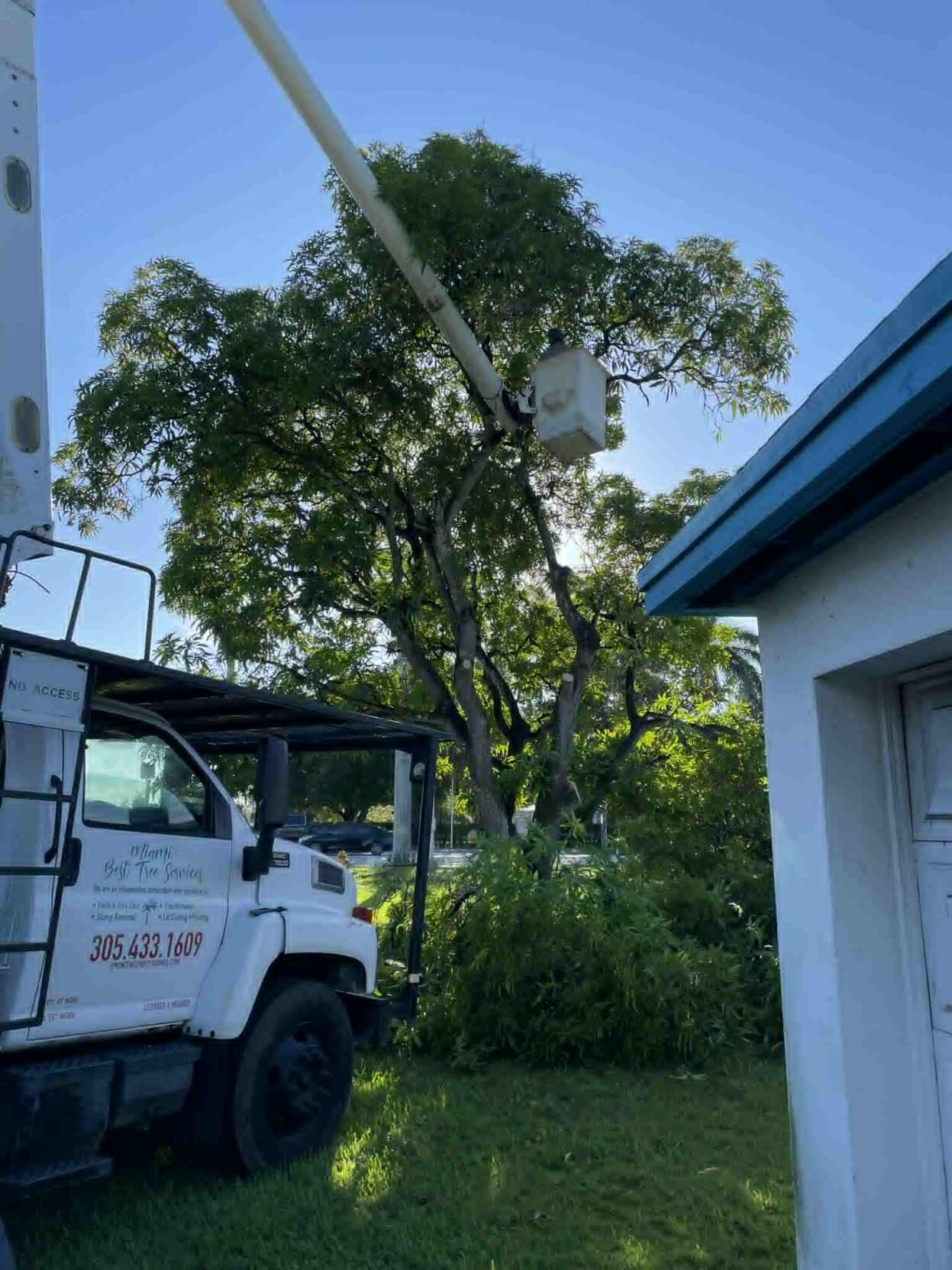
Barbara Van Kessel was friends with Isabelle Krome in her later years. In 1971, the Van Kessels moved onto a property originally owned by the Kromes, where a beautiful mango tree had thrived through the decades. The tree, which bears delicious fruit, brought joy to family, friends, and neighbors who shared in the seasonal offerings.
Unfortunately, in the local ecosystem, destructive pests are as common as bountiful fruit. Last year, when the house had to be tented for termite extermination, Tina Van Kessel was concerned about the tree. At the year-mark, another exterminator came to inspect the house.
Tina explained she had been picking up more broken branches than usual. One branch, about five feet long and eight-to-ten inches in diameter, broke into three pieces after hitting the ground, and a remaining piece was easy for her to pull off. That’s when she noticed the termites. An expert confirmed the presence of subterranean termites and explained that the poison needed to eliminate them would also contaminate the tree’s fruit.
Like many residents in unfenced areas, people often come onto the property to harvest fruit when the family isn’t home. Posting warning signs was unlikely to deter this activity, and her mother was heart-sick at the thought of losing the 100-year-old tree.
Seeking alternatives, representatives from UF/IFAS Extension Miami-Dade County Parks, Recreation, and Open Spaces Department, along with a member of the Tropical Fruit and Vegetable Society Redland, confirmed there were treatments that could be applied without harming the roots. The tree had already sustained significant damage, so the next step was to determine whether cuttings could be taken to “save the genes.”
Louise E. King, Horticulturist at Miami-Dade County Parks, Recreation, and Open Spaces Department, Fruit and Spice Park, quickly responded. She contacted the Van Kessels, who arrived the first week of September with good news.
In a follow-up email, Ms. King explained:
“The ten pieces of budwood that we harvested from Barbara's and Tina's tree were taken back to the nursery at the Fruit & Spice Park where they were grafted onto mango rootstock. The rootstock and budwood were all in good shape, so I have high hopes for the grafts taking hold. We will monitor the grafts closely for the next two to three weeks looking for any signs of sprouting in the new buds. Once the buds start to grow, we will keep the trees in the nursery until spring so they can reach a size suitable for planting. We hope to plant one of the trees here at the park to preserve a piece of Homestead history, and have another to give back to Barbara and Tina to plant at another location on the property.”
Mrs. Van Kessel and her daughter will, of course, miss the historic tree, but they greatly appreciated the help of everyone who responded.
“My mom and I would like to get the word out to look for these types of termites outside of the home,” Tina said. “The original inspector dismissed my concern last year before we had the house tented. The inspector who came for the one-year inspection last week was very concerned. The fumigation performed on a home for termites does not kill subterranean termites. Plus, it can make things worse if they are not spotted outside in the yard.”
For now, at least, while the special tree has been taken down, there is hope that, in the future, there may once again be the delicious fruit that carries on the legacy of Isabelle Krome.

(0) comments
Welcome to the discussion.
Log In
Keep it Clean. Please avoid obscene, vulgar, lewd, racist or sexually-oriented language.
PLEASE TURN OFF YOUR CAPS LOCK.
Don't Threaten. Threats of harming another person will not be tolerated.
Be Truthful. Don't knowingly lie about anyone or anything.
Be Nice. No racism, sexism or any sort of -ism that is degrading to another person.
Be Proactive. Use the 'Report' link on each comment to let us know of abusive posts.
Share with Us. We'd love to hear eyewitness accounts, the history behind an article.