
With baseball nearing postseason, a look back in Homestead history provides some interesting tidbits.
Bob Jensen, often referred to as the "unofficial historian of Homestead," captured the community's early enthusiasm for the game and the short-lived dream of Major League players becoming a common sight in town.
His 2012 article, "Homestead, The Baseball City," chronicles the main events.
"Homestead's first baseball stadium, known as English Park, was constructed in 1921. It was home to the Homestead Tomato Growers baseball team. The stadium was named after J.W. English. The stadium was located near where Harris Field is today.
"In the late summer of 1914, Homestead organized a baseball league and leased five acres of land from William Sykes Sr., just north of the Walker place on the east side of the Detroit road. It was estimated that to put this park in good condition would require $350. The backstop and stands looked to be covered with chicken wire and the surface of the playing field was pretty rough.
"Harry O. Hall, star pitcher of the Tomato Growers baseball team, moved his wife and children to Homestead; he was employed at the Seminole Pharmacy. It was not uncommon for businesses to hire good baseball players to lure them to their hometown teams.
"Dr. James Archer Smith was the second baseman. Florida City resident Glenn Summers also pitched, fielded well and was a strong hitter. Between April and October 1921, the Tomato Growers had a record of 37-3. They scored 371 runs and gave up just 153.
"After the season, newly arrived real estate man — and later mayor — H.A. Cameron wrote the Sporting Editor of the Brooklyn Eagle to challenge the winners of the World Series to a series of games to be played in Homestead. The winner of the series would take all the gate receipts. But there was no response.
"Homestead withdrew from the league in April of 1922.
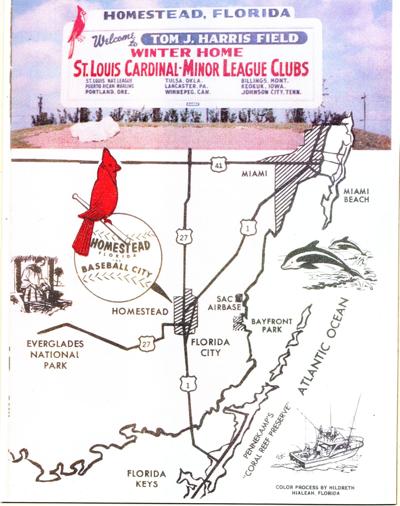
"Four decades later, in April 1961, the St. Louis Cardinals were attracted to Homestead as a site for their minor league teams by the Homestead Redland District Chamber of Commerce. Dick Conley was the president of the chamber at the time and Merl Young was the executive director.
"The City called itself 'Homestead, The Baseball City.' Both Conley and Young were very effective promoters of 'Homestead and Florida City — South Florida's famous twin cities.'
"Stan Musial, the great Cardinals outfielder/first baseman, and outfielder Roberto Clemente of the 1960 world champion Pittsburgh Pirates played in the game at Harris Field, which the home team Cardinals won 4-3.
"The Cardinals fielded such greats as pitchers Curt Simmons and Bob Gibson; catcher Tim McCarver; infielders Ken Boyer and Red Schoendienst; and outfielder Curt Flood.
"The Cardinals' farm teams that carried out spring training in Homestead were the Puerto Rican Marlins and teams from Portland, Oregon; Tulsa, Oklahoma; Lancaster, Pennsylvania; Winnipeg, Canada; Billings, Montana; Keokuk, Iowa; and Jefferson City, Tennessee.
"A billboard announced Homestead, Florida, as the 'Winter Home of the St. Louis Minor League Clubs' and listed them. Many scouts and representatives of sporting goods manufacturers spent time in Homestead during spring training.
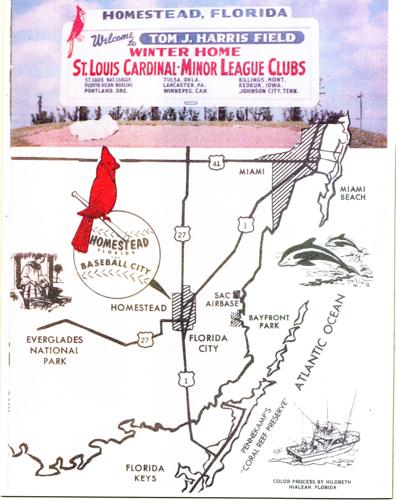
"The Homestead Redland District Chamber of Commerce published a full-color brochure which touted Tom J. Harris Field as winter home of the St. Louis Cardinals' farm clubs and Homestead, The Baseball City. The City of Homestead emblazoned its stationery with the red St. Louis Cardinals logo.
"The Cardinals left Harris Field and were replaced by the Montreal Expos. Little is known of the Expos farm system spring training at Homestead."
Almost 30 years later, the Homestead Sports Complex was to become the spring training site for the Cleveland Indians until that plan was shattered as another impact of Hurricane Andrew's destruction.
Although the complex was rebuilt, Homestead was no longer an option for the team.
In an odd twist, the last time major league players were on the fields was April 1995 because of the MLB strike. Benito Santiago, a well-known catcher and the first player to make a home run for the Miami Marlins, was a free agent at the time.
The turmoil from the strike lingered, and the Major League Baseball Players Association put together a special spring training camp in Homestead for more than two dozen free agents who weren't yet signed.
This was not the kind of spring training the players were accustomed to, but the arrangement did provide a chance for them to work out. Apparently, occasional jokes were made that maybe they could simply create their own team.
Although the term "The Baseball City" may have faded from use, multiple baseball and softball fields throughout the community still provide a place for eager players of all ages.

(0) comments
Welcome to the discussion.
Log In
Keep it Clean. Please avoid obscene, vulgar, lewd, racist or sexually-oriented language.
PLEASE TURN OFF YOUR CAPS LOCK.
Don't Threaten. Threats of harming another person will not be tolerated.
Be Truthful. Don't knowingly lie about anyone or anything.
Be Nice. No racism, sexism or any sort of -ism that is degrading to another person.
Be Proactive. Use the 'Report' link on each comment to let us know of abusive posts.
Share with Us. We'd love to hear eyewitness accounts, the history behind an article.