
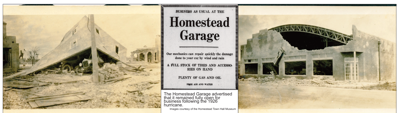
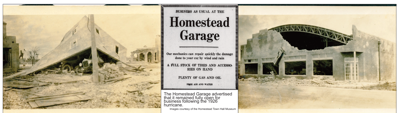
Powerful winds blasted through Homestead and Florida City, causing widespread damage.
Descriptions of the Sept. 18, 1926, storm were provided by Bob Jensen in “Homestead, Florida: From Railroad Boom to Sonic Boom,” by Seth Brasom and Bob Jensen. The book, commissioned by the City of Homestead for the 2013 city centennial, cited this catastrophe as the first among the most notable hurricanes prior to the destruction of Hurricane Andrew.
The 1926 hurricane passed directly over Homestead and Florida City, with winds estimated at 150 mph. It was not as wet as the 1929 hurricane, and no roads were completely submerged, as they were in 1929. The higher winds of the 1926 hurricane downed 120 electric power poles in Homestead, compared with 30 in 1929.
By some estimates, the economic damage of this storm exceeds all others and, factoring in inflation, was three times as expensive as Hurricane Andrew because it struck Miami and Coral Gables.
The University of Miami chose Hurricanes as its sports-team name because of the 1926 hurricane and the ibis as its mascot because folklore has it that the ibis is the last bird to leave before a hurricane.
Both Homestead newspapers were put out of commission by the hurricane. Both lost their roofs. The Homestead Enterprise — successor to Homestead’s first newspaper, the South Florida Banner, and predecessor to the South Dade News Leader — was located on West Mowry. The Homestead Leader was the other newspaper.
The community lost power, and on Sept. 20 it was expected that there would not be power in the business district for two weeks. The old power plant on South Flagler was damaged but not completely destroyed, and the new one on North Flagler was expected to be back in operation.
The City of Homestead maintained water service by using one of its fire trucks to pump water into the mains. It was probably the newer truck — the 1924 American LaFrance Type 75 — rather than the 1917 American LaFrance Type 40 Triple Pumper. The 1924 truck is on display in the Old Town Hall Museum today.
Two deaths were recorded.
Mrs. Elmer Shuck was killed when her home in Goulds collapsed. Her baby, who was in her arms, was only slightly bruised, but her husband was hospitalized. Fred Schutt, son of W.C. Schutt, the Florida City town marshal, was killed in Miami by flying glass.
The back, or east, side of the three-story Horne Building on Krome Avenue was blown off. It was constructed of Denison load-bearing clay blocks, one of which was saved by the Florida Pioneer Museum after the building was demolished following Hurricane Andrew in 1992.
The Methodist Episcopal Church at First Avenue and Fourth Street lost its steeple, which was later replaced with a shorter, less ornate version. The Methodist Episcopal Church South suffered substantial damage, as did most churches in the community.
The cited history placed storm damage at $40,000 to $50,000, or approximately $520,000 to $650,000 in then-current dollars. Almost all of the windstorm insurance was written by Mrs. Grady Smith and her husband. Grady Smith was assistant cashier of the Bank of Homestead from at least 1918 until 1927.
The aftermath of the hurricane did more economic damage in another sense because the Florida land boom of the 1920s was already beginning to wane. The wild speculation, with fortunes made practically overnight through highly questionable practices, would likely have soon collapsed for other reasons, yet the hurricane was a contributing factor.
A second hurricane in 1928 added to the woes, with the Great Depression of 1929 plunging the entire country into dire times.
The Homestead Town Hall Museum’s new centennial exhibit on the 1926 hurricane includes photographs and information about this difficult period.
An interesting note is that while two primary garages — the Dodge Garage and the Charles Fuchs Jr. Garage — were severely damaged, the Homestead Garage ran an advertisement saying it was fully open for business.
The museum, located at 41 North Krome Avenue across from Losner Park, is open Tuesday through Saturday from 1 to 5 p.m. Admission is free

(0) comments
Welcome to the discussion.
Log In
Keep it Clean. Please avoid obscene, vulgar, lewd, racist or sexually-oriented language.
PLEASE TURN OFF YOUR CAPS LOCK.
Don't Threaten. Threats of harming another person will not be tolerated.
Be Truthful. Don't knowingly lie about anyone or anything.
Be Nice. No racism, sexism or any sort of -ism that is degrading to another person.
Be Proactive. Use the 'Report' link on each comment to let us know of abusive posts.
Share with Us. We'd love to hear eyewitness accounts, the history behind an article.